Forget the complex textbook rules. In real life, this choice is about storytelling and clarity. 🗣️✨
The Main Concept: The “Anchor Point” ⚓️
To understand Past Perfect, you must understand Past Simple first.
1. Past Simple = Your Default Timeline ➡️➡️➡️
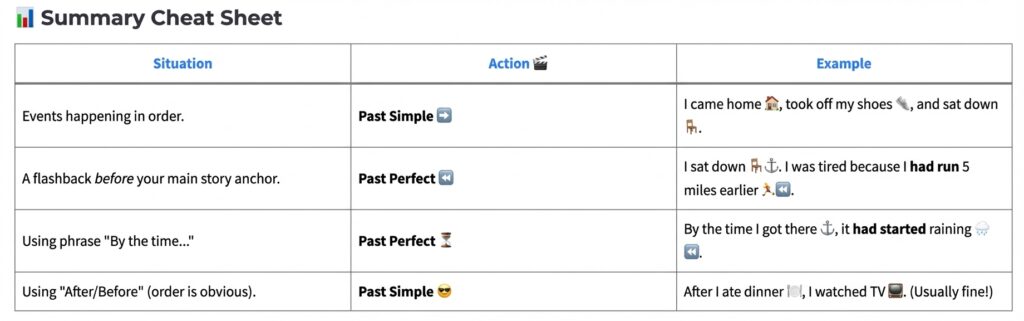
This is the main road of your story. Events happen in order.
“I woke up ⏰, drank coffee ☕️, and went to work 💼.” (Event 1 ➡️ Event 2 ➡️ Event 3)
2. Past Perfect (had done) = A Flashback ⏪
You only use this when you have already established a point in the past (an “Anchor Point” ⚓️), and you want to jump backward from it.
The Golden Rule: 🥇 You cannot use the Past Perfect flashback ⏪ unless you already have a Past Simple anchor ⚓️ in the story.
The “Real Life” Litmus Test 🧪
When speaking, ask yourself these two questions:
Question 1: Am I telling story events in the exact order they happened? ➡️➡️➡️
Yes: Use Past Simple. “I opened the door 🚪 and saw the dog 🐕.”
No: Go to Question 2.
Question 2: Do I need to clarify that one specific action finished before another to avoid confusion? 🤔
Yes: Use Past Perfect for the earlier action (the flashback).
“I saw the dog 🐕⚓️. Someone had opened the door 🚪⏪.” (The door opened before I saw the dog).
4 Real Life Scenarios for Past Perfect ⏪
1. The “Arriving Late” Effect (Crucial Sequencing) 🏃♂️💨🚫🚆
You arrive at a past scene ⚓️, and something finished before you got there.
The Confusion (Simple + Simple): 😕
“When I arrived at the station 🚉, the train left 🚆.”
Sounds like it left exactly when you arrived. You might have jumped on!)
The Clarity (Simple ⚓️ + Perfect ⏪): 💡
“When I arrived at the station 🚉⚓️, the train had left 🚆⏪.”
(Clear gap in time. You definitely missed it.)
2. Explaining “Why” (Reasons and Results) 🤔➡️😠
Use the flashback to explain the reason for a past emotion.
The Result (Anchor ⚓️): I was really angry yesterday 😡⚓️.
The Reason (Flashback ⏪): Because my brother had eaten my leftover pizza 🍕⏪.
3. The “By the Time” Trigger ⏳
If you use the phrase “By the time [X happened]…“, you almost guarantee need Past Perfect for the next part.
“By the time I got home 🏠⚓️, my husband had cooked dinner 🍳⏪.”
4. Reported Speech / Gossip 🗣️👂🤫
When telling someone today about what someone said yesterday.
Direct speech (Yesterday): John says: “I finished the report ✅.”
Gossip (Today): “Did you talk to John?” “Yeah, he told me 🗣️⚓️ that he had finished the report ⏪.”
The Secret: When to SKIP it 🤫⚡️
Native speakers love efficiency. If the order of events is obvious without the extra “had,” we often just use Past Simple.
Linking words like Before or After usually make the timeline clear enough.
Grammatically “Perfect”: 🧐 “After I had brushed my teeth 🪥⏪, I went to bed 🛌⚓️.”
Real Life Daily Speech: 😎 “After I brushed my teeth 🪥➡️, I went to bed 🛌➡️.”
(The second one is totally fine in casual conversation because “After” does the job of clarifying the order!)
Evaluation Test:
Okay, let’s test your real-world instinct.
For each scenario below, I will give you a situation and a sentence with two blanks. You need to choose the correct combination of tenses:
A: Past Simple / Past Simple
B: Past Simple / Past Perfect (or vice versa depending on sentence order)
I will provide the answers and explanations after you try all five.
Scenario 1: The Cinema Trip
You and your friend went to see a movie last night. You want to tell someone that you arrived at the cinema 10 minutes late, so you missed the very beginning of the film.
“When we __________ (arrive) at the cinema, the movie __________ (already / start).”
A: arrived / started
B: arrived / had already started
Scenario 2: The Morning Routine
You are describing your normal routine yesterday morning. The actions happened one after the other in a sequence.
“I __________ (wake up) and __________ (have) a shower.”
A: woke up / had
B: had woken up / had
Scenario 3: The Dirty Kitchen
You came home yesterday evening to find the kitchen was a disaster zone because your roommate cooked a big meal earlier in the day and didn’t clean up.
“The kitchen was dirty when I got home because my roommate __________ (cook) a huge curry.”
A: cooked
B: had cooked
Scenario 4: Using “After”
You are telling a simple story about your evening. The word “after” makes the order of events clear.
“After I __________ (finish) work, I __________ (meet) Sarah for a drink.”
A: finished / met
B: had finished / met
Scenario 5: The Surprise Party
You tried to organize a surprise party for John, but someone ruined the surprise before he arrived.
“By the time John got to the party, someone __________ (tell) him about the surprise.”
A: told
B: had told
Answers
Scenario 1: The Cinema Trip
“When we arrived at the cinema, the movie had already started.”
Correct Answer: B
Why: This is crucial sequencing. You need to emphasize that there was a gap between the movie starting and your arrival. If you used Past Simple for both (“When we arrived, the movie started”), it sounds like your arrival caused the movie to begin at that exact second.
Scenario 2: The Morning Routine
“I woke up and had a shower.”
Correct Answer: A
Why: This is just a list of events in chronological order. There is no flashback necessary. Past Simple is sufficient.
Scenario 3: The Dirty Kitchen
“The kitchen was dirty when I got home because my roommate had cooked a huge curry.”
Correct Answer: B
Why: You are explaining the reason for a past state.
Anchor point (Past Simple): The kitchen was dirty when I got home.
Flashback reason (Past Perfect): Because the cooking happened earlier in the day.
Scenario 4: Using “After”
“After I finished work, I met Sarah for a drink.”
Correct Answer: A
Why: The word “After” makes the order of events 100% clear. While it is grammatically acceptable to say “After I had finished…”, in real life, native speakers usually prefer the simpler version because the Past Perfect feels unnecessary.
Scenario 5: The Surprise Party
“By the time John got to the party, someone had told him about the surprise.”
Correct Answer: B
Why: The phrase “By the time…” is almost always a trigger for the Past Perfect. It sets a deadline in the past, and you are reporting something that was completed before that deadline hit.