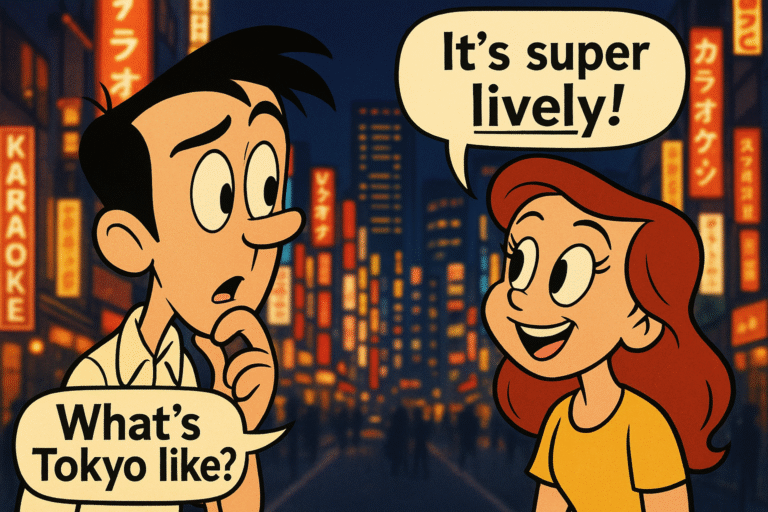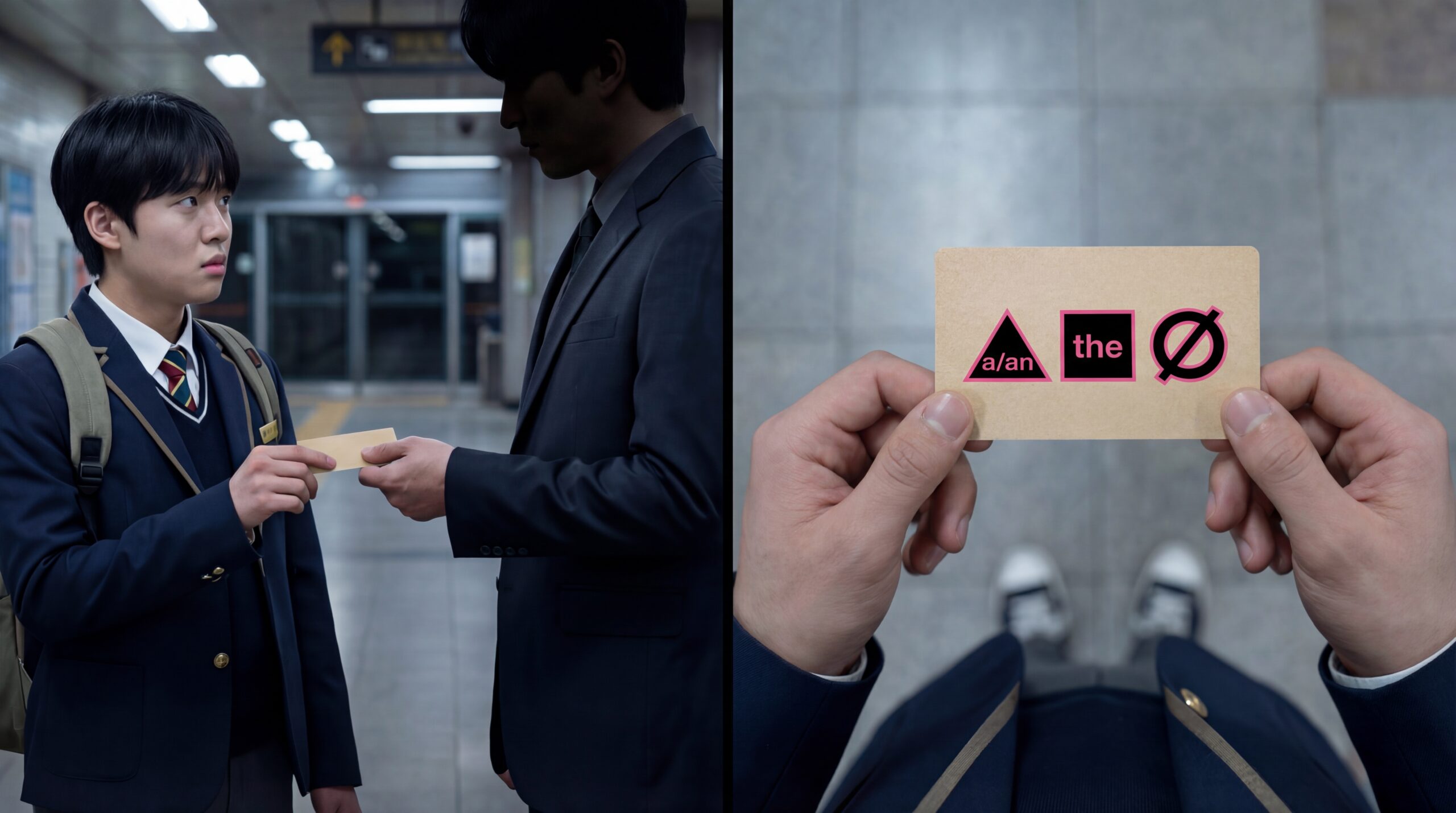
This lesson will show you the most common types of article mistakes that students make in IELTS Speaking. Learn and practice! But first, let’s start by testing your current knowledge and instinct with articles below!
The Band 6 Article “Cleanup” Guide
The goal here isn’t to re-teach you every rule about articles from scratch. The goal is to fix the specific habits that keep slipping out during speech. Let’s look at the 4 main category where students make mistakes and then test yourself to see what you’ve learned!
Category 1: The “Missing ‘A/AN'” Mistake
The Problem: When speaking quickly, students often drop the indefinite article when introducing a singular countable noun, especially when an adjective is attached, or when stating their job/role.
The Rule to Remember for Speaking: If you can count it, and there is only one of it, it must have a little word before it (a, an, my, this).
Common Mistakes and Fixes:
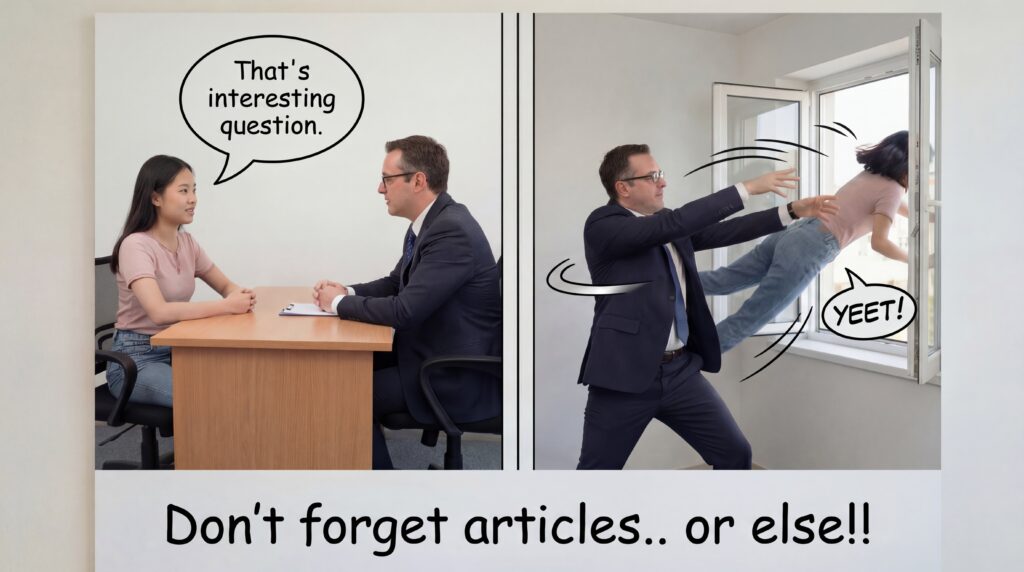
1. ❌ Incorrect: It’s interesting question. / It’s tricky question.
✅ Correct: It’s an interesting question. / It’s a tricky question. (Don’t let the adjective make you forget the article for the noun ‘question’).
2. ❌ Incorrect: It’s really nice place.
✅ Correct: It’s a really nice place.
3. ❌ Incorrect: when you live in apartment.
✅ Correct: when you live in an apartment.
4. ❌ Incorrect: it’s quite small town.
✅ Correct: It’s quite a small town.
5. ❌ Incorrect: I am football fan.
✅ Correct: I am a football fan. (Jobs, roles, and identities always take ‘a/an’).
6. ❌ Incorrect: I’m the person who is quite busy.
✅ Correct: I’m a pretty busy person! (You are just one of many busy people, not the only one defined by business).
Category 2: The “Missing ‘THE'” Mistake
The Problem: Band 6 students often omit ‘THE‘ in four specific situations: A) shared knowledge/systems, B) unique nature, C) specific definitions, and D) fixed time phrases.
The Rule to Remember for Speaking: If there is only one of these things in our shared world (the sun, the internet), or if we both know which specific one I’m talking about (the gym, the airport), use ‘THE‘.
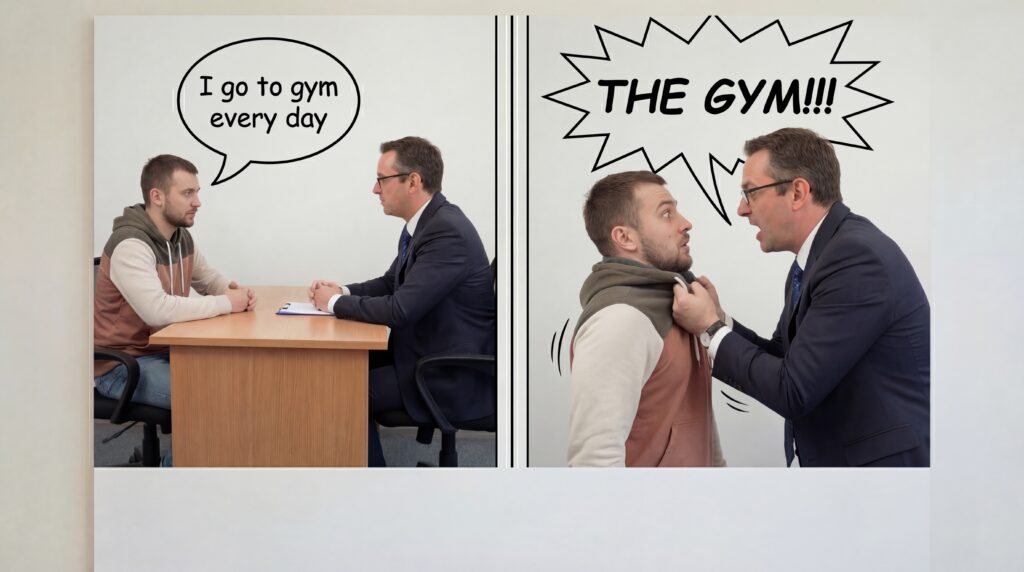
A) Systems, Services, and Shared Places (We all know which type of place it is)
1. ❌ Incorrect: I went to park.
✅ Correct: I went to the park.
2. ❌ Incorrect: I usually hit gym in the evening.
✅ Correct: I usually hit the gym in the evening.
3. ❌ Incorrect: I sometimes visit beach.
✅ Correct: I sometimes visit the beach.
4. ❌ Incorrect: I head to cinema at least once a week..
✅ Correct: I head to the cinema at least once a week.
5. ❌ Incorrect: I popped into shop.
✅ Correct: I popped into the shop.
6. ❌ Incorrect: I used to take bus.
✅ Correct: I used to take the bus.
7. ❌ Incorrect: I take metro.
✅ Correct: I take the metro.
8. ❌ Incorrect: We need to take elevator.
✅ Correct: We need to take the elevator.
B) Unique Things, Media, and Nature (There is only one)

1. ❌ Incorrect: I love mountains.
✅ Correct: I love the mountains.
2. ❌ Incorrect: I was brought up in countryside.
✅ Correct: I was brought up in the countryside.
3. ❌ Incorrect: I plan on moving to city.
✅ Correct: I plan on moving to the city.
4. ❌ Incorrect: I was watching news.
✅ Correct: I was watching the news.
5. ❌ Incorrect: She listens to BBC.
✅ Correct: She listens to the BBC.
6. ❌ Incorrect: I saw it on internet
✅ Correct: I saw it on the internet (System name).
7. ❌ Incorrect: Weather here is mental.
✅ Correct: The weather here is mental.
8. ❌ Incorrect: We should protect environment.
✅ Correct: We should protect the environment.
C) Specificity and Ordinals (Making it exact)
1. ❌ Incorrect: We went to a cafe. Cafe had a nice vibe.
✅ Correct: We went to a cafe. The cafe had a nice vibe. (We already mentioned a cafe, now we refer back to it).
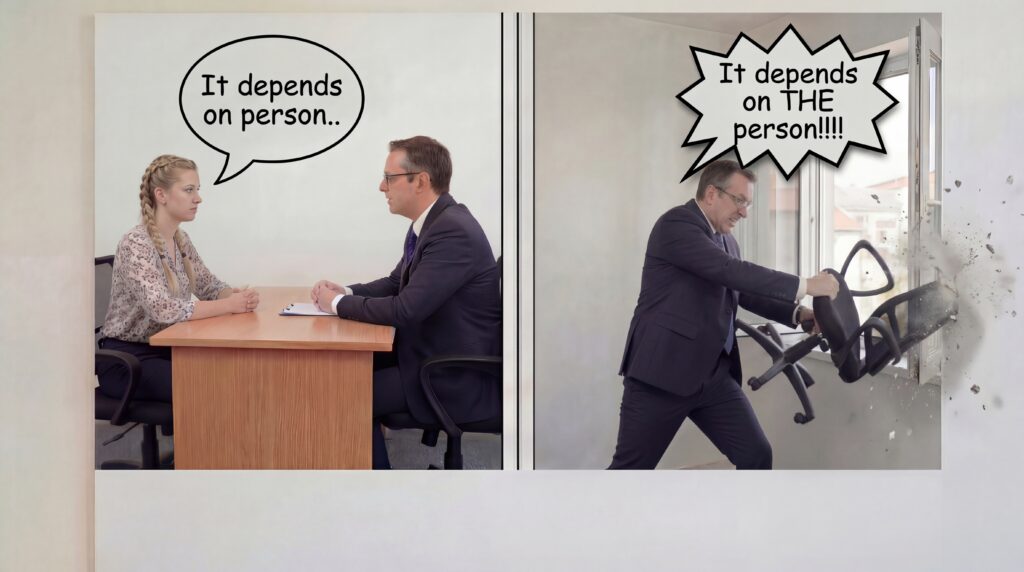
2. ❌ Incorrect: It depends on person.
✅ Correct: It depends on the person. (We aren’t talking about any person, but the specific person)
3. ❌ Incorrect: We come from same country.
✅ Correct: We come from the same country. (‘Same’ almost always has ‘the‘ before it).
4. ❌ Incorrect: It was right decision.
✅ Correct: It was the right decision. (When there is only one correct option).
5. ❌ Incorrect: It was first time I tried oysters.
✅ Correct: It was the first time I tried oysters. (Ordinal numbers like first, second, last usually have ‘the‘ before it).
6. ❌ Incorrect: He was winner.
✅ Correct: He was the winner. (There is only one specific winner).
7. ❌ Incorrect: I had opportunity/chance to…
✅ Correct: I had the opportunity/chance to…
D) Fixed Time Phrases

1. ❌ Incorrect: I like to chill out on weekend.
✅ Correct: I like to chill out on the weekend.
2. ❌ Incorrect: I want to go there in future.
✅ Correct: I want to go there in the future (also: in the past).
3. ❌ Incorrect: I start early in morning.
✅ Correct: I start early in the morning.
Category 3: The “Unnecessary Article” (Adding ‘A’ or ‘THE’ wrongly)
The Problem: Overcorrecting by adding articles where none are needed, particularly with plurals, proper nouns, and idiomatic phrases about routines.
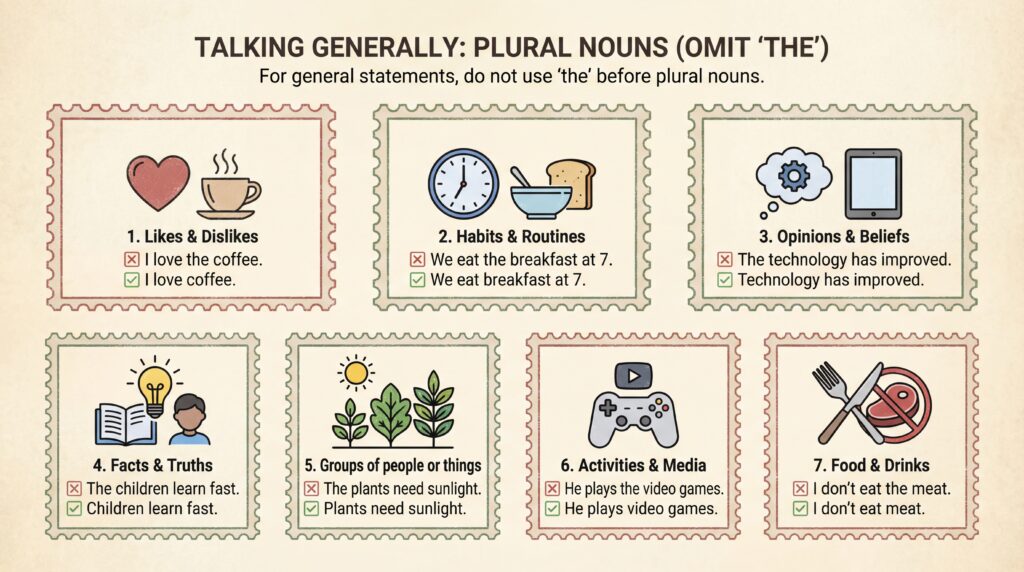
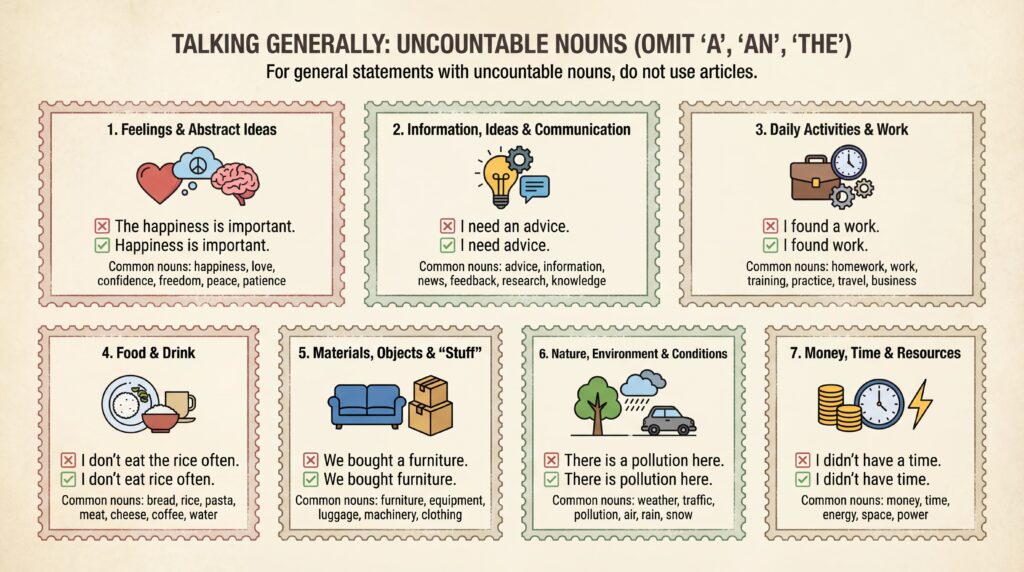
A) Plurals and Uncountables (General Statements)
Rule: When talking generally about plural things or uncountable concepts, use NO article.
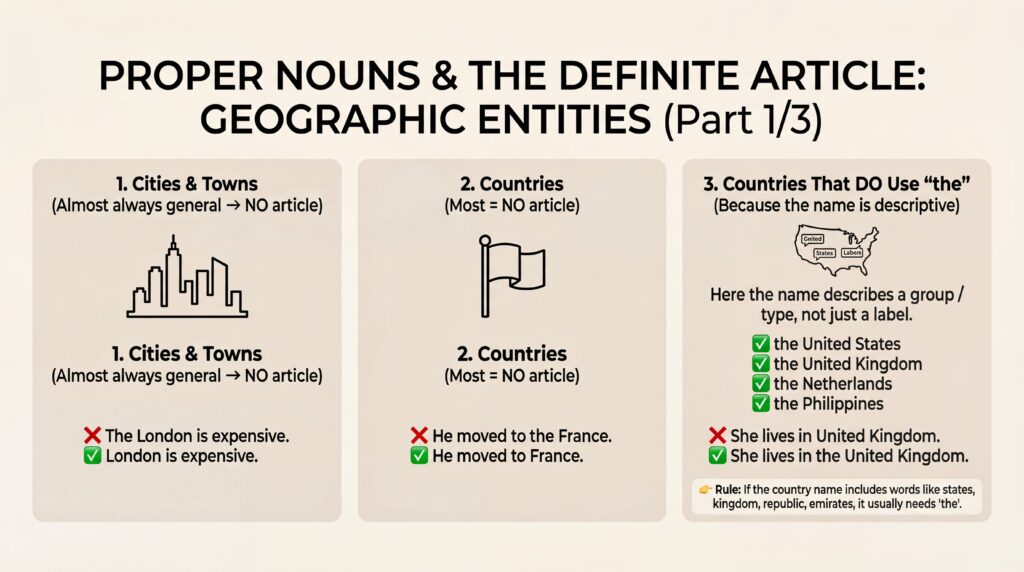
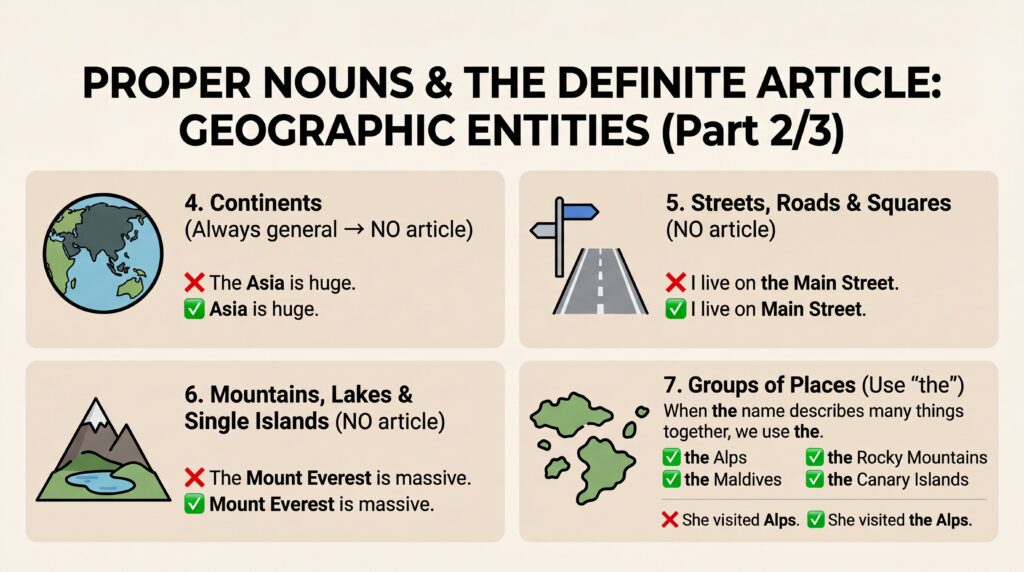
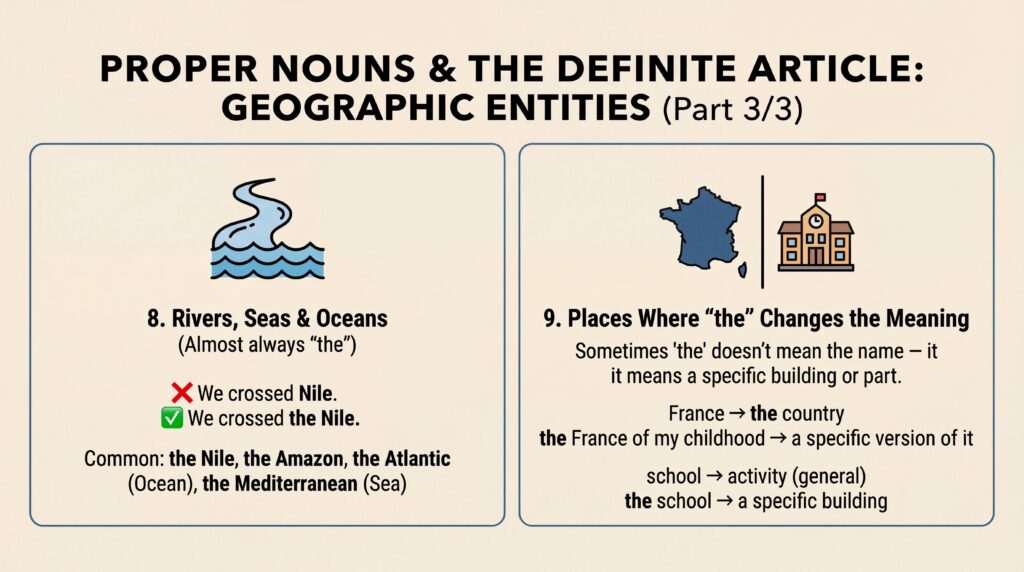
B) Proper Nouns (Names of Places)
Rule: Most countries and cities do not have ‘THE‘. before it. Exceptions include plural names (The Philippines) or names with “Republic/Kingdom/States” (The UK, The US).
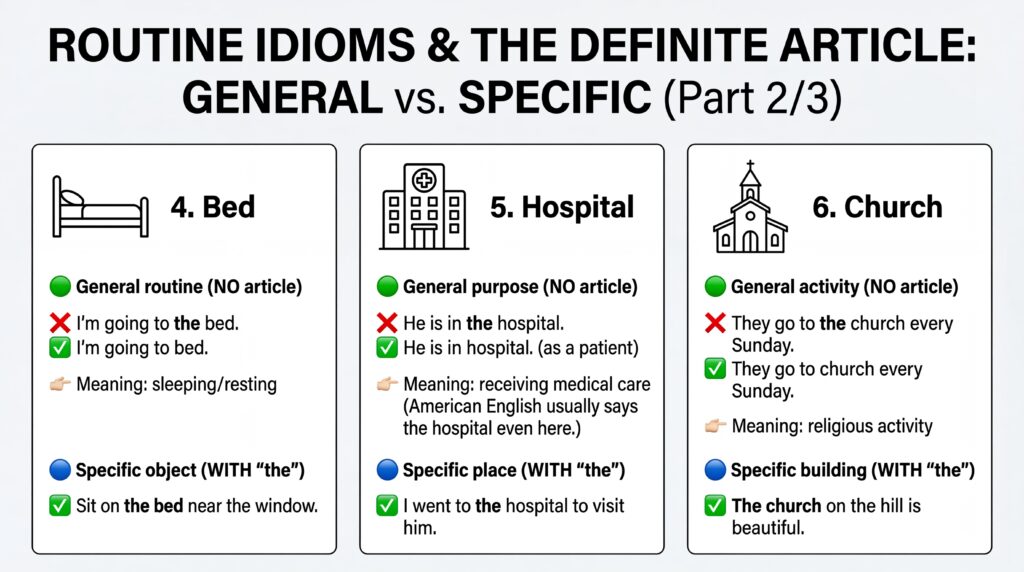
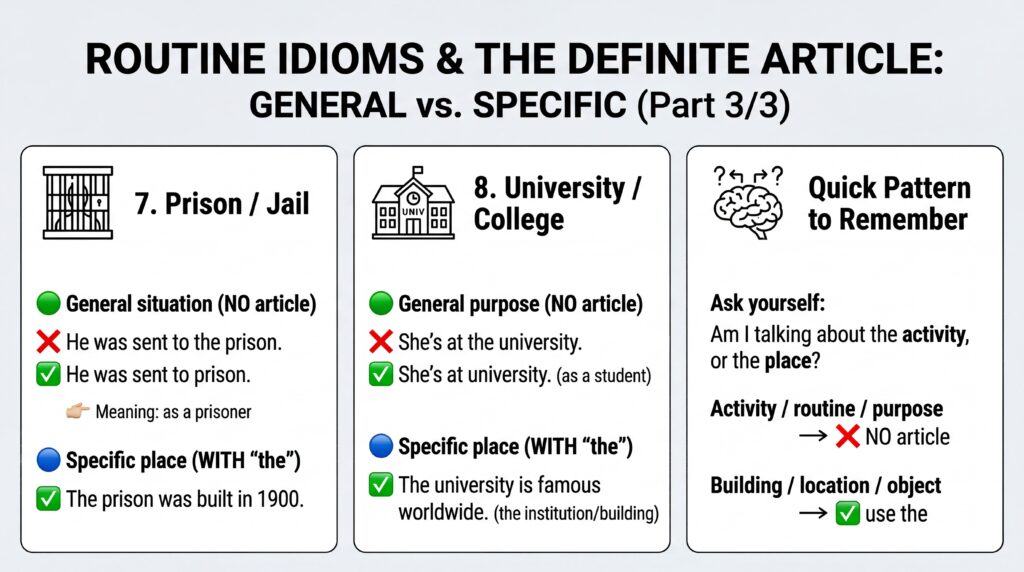
C) Routine Idioms (Home, Work, Bed, School)
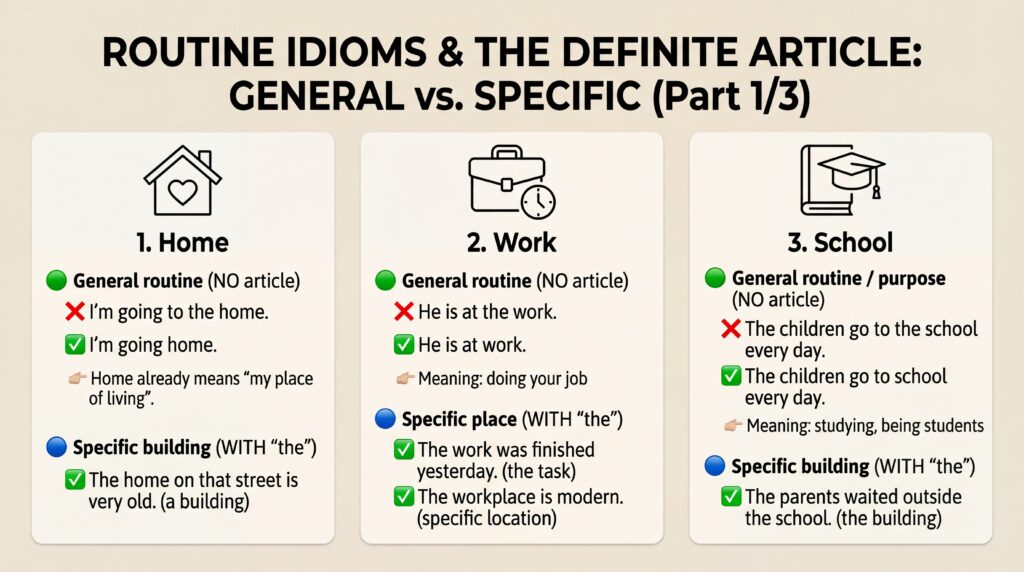
Rule: When these places are used for their primary purpose as part of a routine, they use ZERO article.
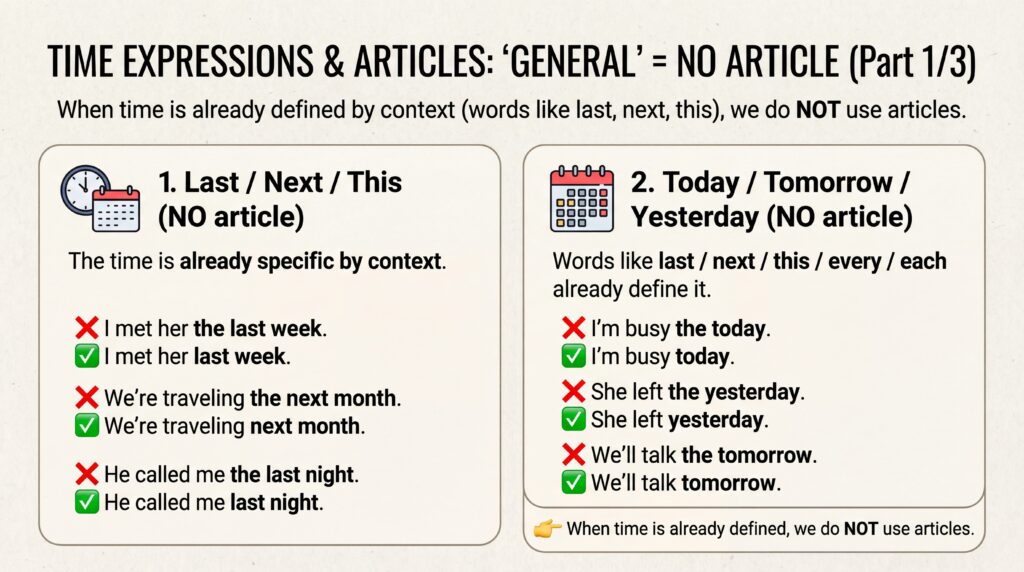
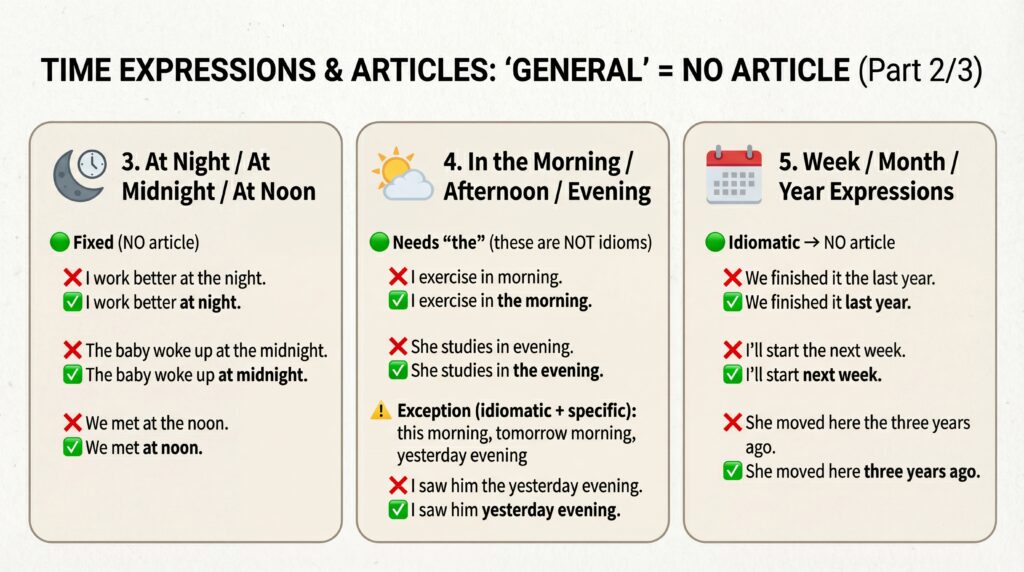
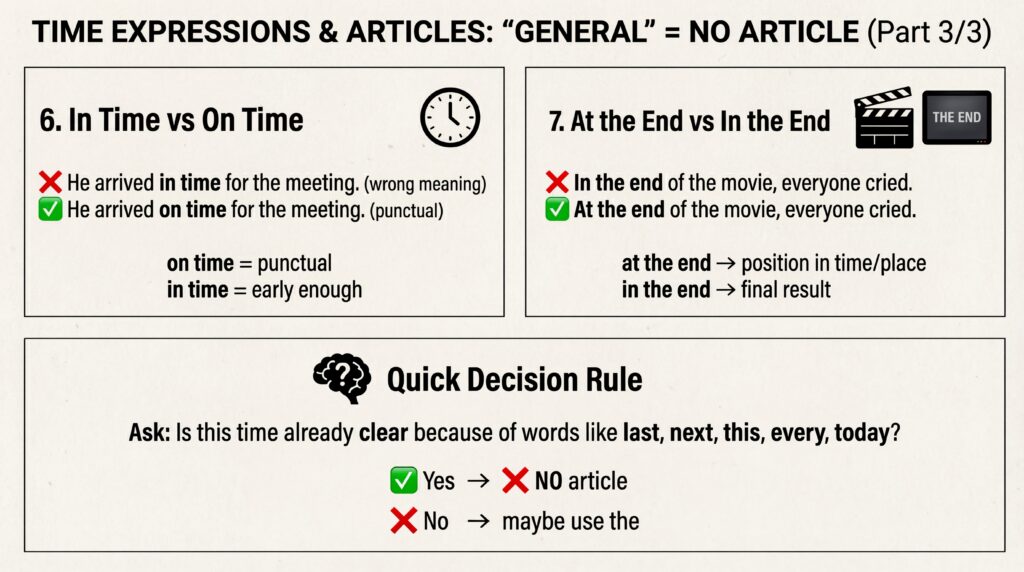
D) Time Idioms with Last/Next/Night
Category 4: The “Quantifier Confusion” (Most of…)
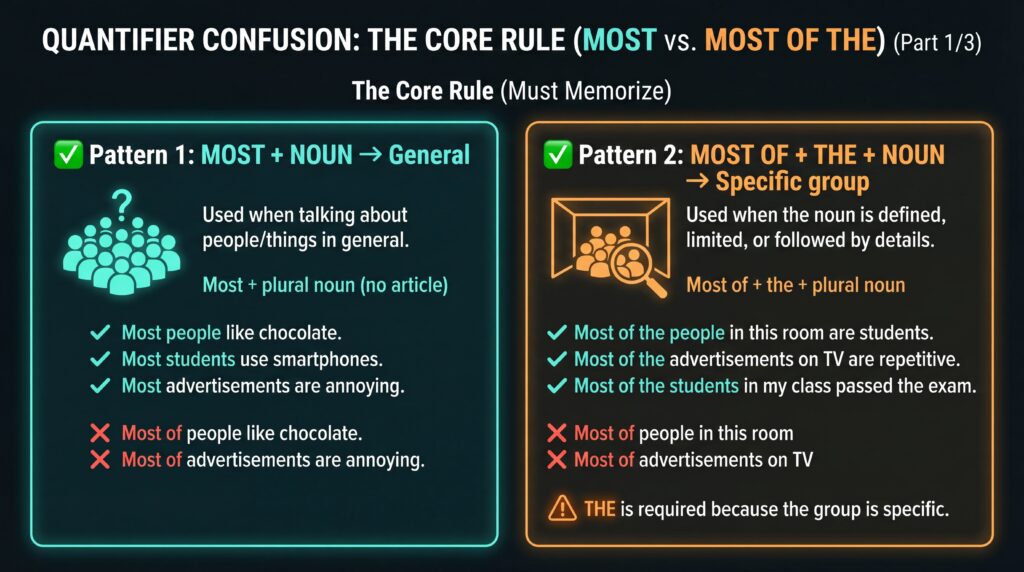
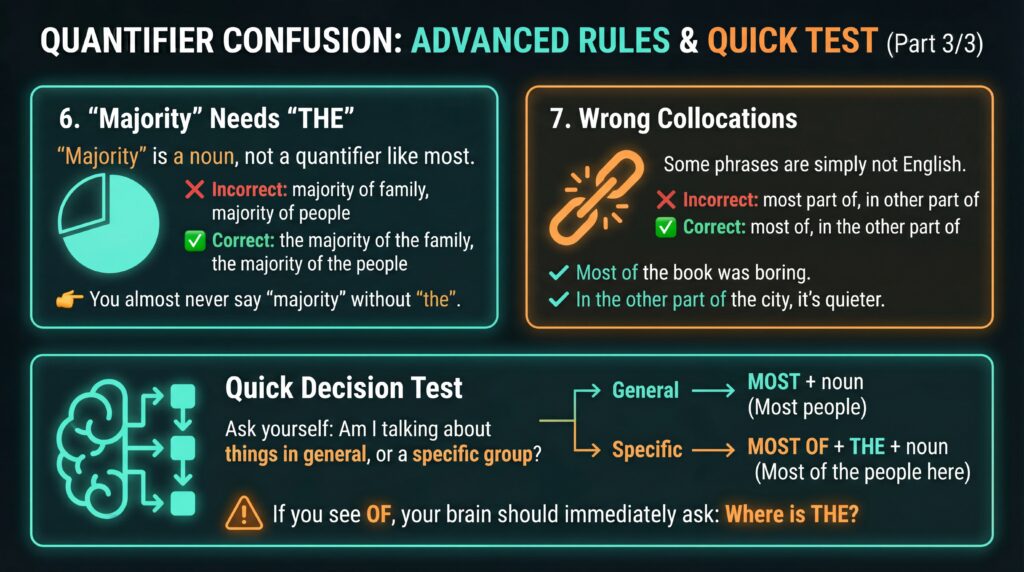
The Problem: Students mix up “Most people” with “Most of the people.” and often forget the article.
The Rule:
Most + Noun = General speaking (“Most people like chocolate.”)
Most + OF + THE + Noun = Specific group (“Most of the people in this room are students.”)
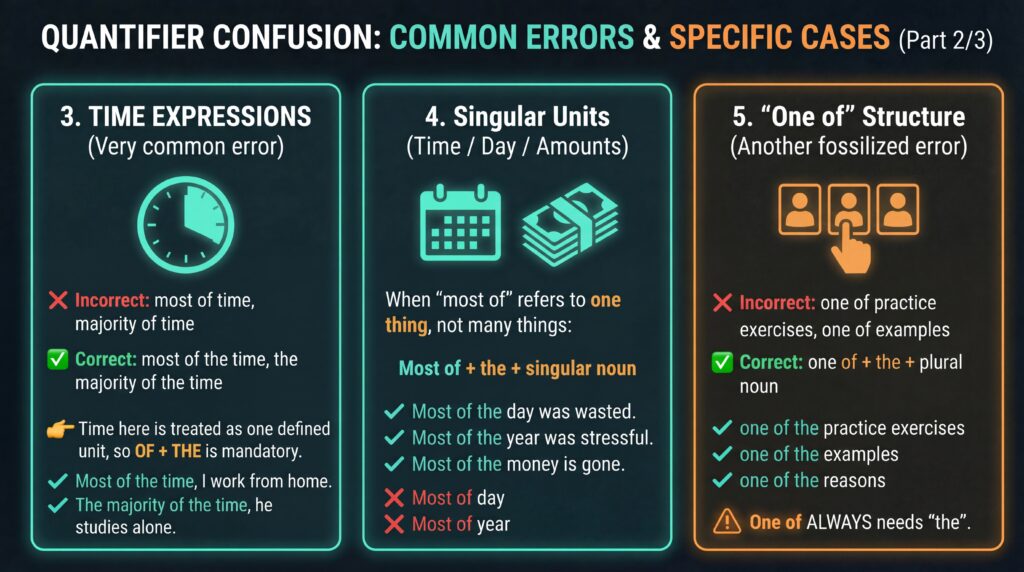
Most + OF + THE + Singular Noun (Time/Day) = A large part of one unit.
The biggest error pattern in the data is missing “THE” after “OF”.
Test
Instructions: This test is divided into five sections. Read the instructions for each section carefully. Take your time and think about whether the noun is general, specific, countable, uncountable, or a proper name.
Section A: The Essentials (Multiple Choice)
Choose the correct option (a, b, c, or d) to complete the sentence.
- I need to buy ___ new laptop for university.
a) a
b) an
c) the
d) Ø (no article) - Could you please pass me ___ salt? (The speaker is pointing to the salt shaker on the table).
a) a
b) an
c) the
d) Ø - ___ information you gave me yesterday was very helpful.
a) A
b) An
c) The
d) Ø - My brother is ___ accountant at a big firm in the city.
a) a
b) an
c) the
d) Ø - Did you see ___ moon last night? It was huge!
a) a
b) an
c) the
d) Ø
Section B: Find the Error (Categories 1, 2 & 3)
Read the sentences below. If the sentence is correct, write “Correct.” If it is incorrect, rewrite the sentence fixing the article error (add ‘a/an’ or ‘the’, or remove an unnecessary article).
- She wants to be dentist when she grows up.
- I don’t like the tea; I prefer coffee. (Talking generally)
- Where is book I lent you last week?
- He migrated to the Germany in 2015.
- We have a homework to do tonight.
- The happiness is the most important thing in life.
- I have an excellent idea for our project.
Section C: General vs. Specific & Proper Nouns
Complete the sentences using “the” or Ø (zero article).
- I love looking at _________ old buildings; architecture fascinates me. (General interest)
- Look at _________ old buildings over there; they are being demolished. (Specific ones nearby)
- He is currently studying at _________ university. (His general activity)
- The conference is being held at _________ University of Tokyo. (Specific institution name)
- We are planning a trip to _________ Philippines next summer.
- _________ Mount Fuji is the highest peak in Japan.
- They always go to _________ church on Sundays. (Routine religious activity)
- I’ll see you _________ next week.
Section D: The Quantifier Challenge (Most vs. Most of…)
Choose the correct quantifier structure to complete the sentence.
- ___________ students hate taking early morning exams. (General statement)
a) Most
b) Most of
c) Most of the - ___________ cars in this parking lot are expensive brands. (Specific group)
a) Most
b) Most of
c) Most of the - We spent ___________ the day cleaning the garage. (Singular unit of time)
a) most
b) most of
c) the majority - It is one of ___________ toughest challenges I’ve ever faced.
a) the
b) a
c) Ø - ___________ time, I just relax on the weekends. (Idiomatic time expression)
a) Most of
b) The most of
c) Most of the
Section E: The Mastery Paragraph
Read the paragraph below. There are 10 gaps. Fill each gap with ‘a’, ‘an’, ‘the’, or ‘Ø’ (zero article).
Last summer, my friend and I decided to take (26) ___ trip to Europe. We started in (27) ___ Paris, because we both love (28) ___ French art. We visited (29) ___ Louvre Museum to see Mona Lisa. After a few days, we took a train to Italy. On the train, we met (30) ___ interesting old man who told us stories about his life. He used to be (31) ___ engineer in the 1970s. When we arrived in Rome, we were shocked by (32) ___ traffic; it was chaotic! However, (33) ___ food we ate that night was incredible. It was definitely (34) ___ best pizza I have ever had. Overall, (35) ___ travel broadens the mind.
Reveal Answers
Section A: The Essentials
- a) a new laptop (Singular, countable, nonspecific noun starting with a consonant sound. Category 1)
- c) the salt (Specific item shared by speaker and listener in the immediate context. Category 2)
- c) The information (Specific because of the phrase “you gave me yesterday”. Category 2)
- b) an accountant (Singular, countable profession starting with a vowel sound. Category 1)
- c) the moon (Unique object—there is only one moon for Earth. Category 2)
Section B: Find the Error
- She wants to be a dentist… (Professions are singular countable nouns. Category 1)
- I don’t like Ø tea; I prefer coffee. (General statement about uncountable food/drink. Category 3)
- Where is the book I lent you…? (Specific book defined by the relative clause “I lent you”. Category 2)
- He migrated to Ø Germany… (Most country names do not use ‘the’. Category 3)
- We have Ø homework to do tonight. (Homework is uncountable. You cannot have “a” homework. Category 3)
- Ø Happiness is the most important… (Abstract noun used generally. Category 3)
- Correct. (Singular countable noun beginning with a vowel sound. Category 1)
Section C: General vs. Specific & Proper Nouns
- Ø (General plural noun).
- the (Specific plural nouns pointed out by “over there”).
- Ø (Idiom for routine activity/purpose of studying).
- the (Proper noun with “of” structure, specifically naming the institution).
- the (Plural country name/group of islands).
- Ø (Single mountain names usually have no article).
- Ø (Idiom for routine religious activity).
- Ø (Time expression defined by “next”—no article needed).
Section D: The Quantifier Challenge
- a) Most (General plural noun: Most + Noun).
- c) Most of the (Specific group defined by location: Most of + the + Noun).
- b) most of (Singular unit of time: Most of + the + Singular Noun).
- a) the (The “one of” structure always requires “the”).
- c) Most of the (Fixed time idiom requiring “the”).
Section E: The Mastery Paragraph
1. Ø (General uncountable concept/activity).
2. a (A nonspecific trip, singular countable).
3. Ø (City name).
4. Ø (General uncountable concept).
5. the (Specific, famous building name).
6. an (A nonspecific person, singular countable starting with a vowel sound).
7. an (Profession, singular countable starting with a vowel sound).
8. the (Specific uncountable noun—the traffic in Rome at that time).
9. the (Specific food defined by “we ate that night”).
10. the (Superlative adjective “best”).
Total Points: 35
The student is struggling with fundamental article rules. A complete re-study of all four categories is necessary, starting from the basics of countable vs. uncountable nouns.
32 – 35 points (90% – 100%): Excellent Mastery.
The student has a solid grasp of the rules and exceptions. Errors are rare and likely due to carelessness rather than a lack of understanding.
27 – 31 points (75% – 89%): Good Understanding.
The student understands the core concepts well but may still struggle with some exceptions, idiomatic expressions, or specific quantifier rules. A review of the weaker categories is recommended.
20 – 26 points (55% – 74%): Needs Practice.
The student understands the basic rules (A vs. An, some uses of The) but frequently makes errors with zero articles, proper nouns, and quantifiers. A thorough review of Categories 3 and 4 is needed.
Below 20 points (Below 55%): Significant Gaps.
The student is struggling with fundamental article rules. A complete re-study of all four categories is necessary, starting from the basics of countable vs. uncountable nouns.