Instructions: Try the test below to assess your subject-verb matching use. It is designed to check your instinct for matching subjects and verbs in spoken English. Complete both parts below. Try to do it quickly, without overthinking, just as you would when speaking. After that, go through the notes to understand the main mistakes with subject-verb matching.
Mistake 1: The Missing 3rd Person Singular ‘S’ on Main Verbs
He like, She go, It make me, He want ❌
This is the single most persistent error in speaking, and it’s essential that you fix this mistake if you want band 7 in grammar.
It tends to be a big problem among Asian students (🇨🇳, 🇻🇳, 🇹🇭, 🇯🇵, 🇰🇷), but it’s also an issue for Turkish 🇹🇷 and Arabic-speaking nations (🇸🇦 🇪🇬 🇦🇪 🇲🇦 🇯🇴 🇮🇶 🇰🇼 🇶🇦 🇴🇲 🇧🇭 🇩🇿 🇹🇳 🇱🇾 🇸🇩 🇾🇪 🇸🇾 🇱🇧 🇵🇸). Even romance languages speakers (🇪🇸, 🇮🇹, 🇵🇹, 🇫🇷) struggle with this rule.
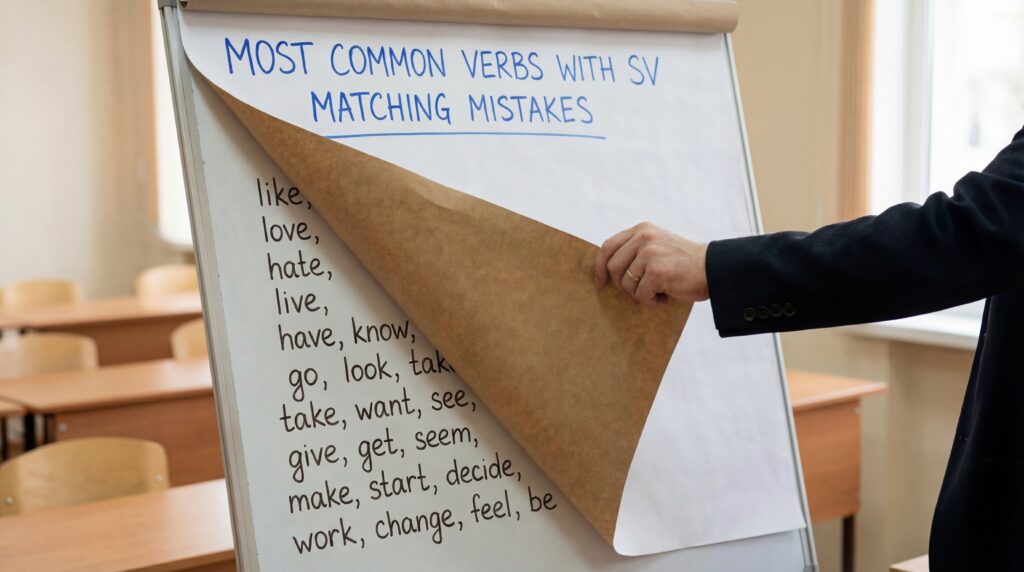
Practice using these common verbs over and over again to make sure you’ve mastered them!
Practice Exercise: Gap-Fill Quick Fire 🔥
Purpose
This drill helps you to quickly choose the verb form that matches the subject.
Instructions: Read the story and verbally fill in the gaps verbally. Start slow and then speed up until it becomes too easy. The first one has been done for you.
Word list:
🏠Live / 💼Work / ❤️Like / 🤩Want / 🙏Need / 🤲Have / 🧠Know / See / 🟢Go / 🤛Take / 🔨Make / 🫴Give / 😌Feel / 🤔Seem / 🏁Start/ 👀Look
Colin 1) 🏠 lives in a small town near the mountains, while Sally and Bella 2) 🏠 ______ near the park on the other side of town. Although they all 3) 💼 ______ at the same bookstore, their schedules are different. Colin 4) 💼 ______ in the afternoon and evening, but Sally and Bella 5) 💼 ______ in the morning. Colin 6) 🤲 ______ a small apartment by the river, and he 7) ❤️ ______ the quiet view because he can 8) 👀 ______ the water from his window. Sally and Bella 9) 🤲 ______ an apartment together, and they 10) ❤️ ______ living near the park since they can walk to work. While Sally and Bella 11) 🟢 ______ to work at 8:00 a.m., Colin usually sleeps because he 12) 😌 ______ tired after working late. They 13) 🤛 ______ their bicycles, but he 14) 🤛 ______ the bus when he 15) 🟢 ______ to work at 2:00 p.m. At the bookstore, Sally and Bella 16) 🔨 ______ coffee and 17) 🫴 ______ friendly service, so customers often say the store 18) 🤔 ______ warm and welcoming. Because they 19) 🤩 ______ to become teachers, they 20) 🏁 ______ studying at the library after work, and they 21) 🤛 ______ their notebooks with them. They 22) 🧠 ______ that they 23) 🙏 ______ good grades, so they work hard even when they 24) 😌 ______ tired. Meanwhile, Colin 25) 🏁 ______ work when the store is quiet, and he 26) ❤️ ______ the calm atmosphere because he can talk to customers about books. He 27) 🧠 ______ many stories, and he often 28) 🔨 ______ recommendations when people ask for advice. After work, Colin 29) 🟢 ______ to a café where he 30) 🤛 ______ his notebook and 31) 🏁 ______ writing. Although he sometimes 32) 👀 ______ at a blank page and nothing happens, he does not stop because he 33) 🤩 ______ to become a writer. He 34) 🧠 ______ that he 35) 🙏 ______ practice, and he believes that hard work will help him improve. Even though their schedules are different, their lives 36) 🤔 ______ connected because they all 37) 🤲 ______ dreams that they work hard to achieve.
Answers
Colin 1) 🏠 lives in a small town near the mountains, while Sally and Bella 2) 🏠 live near the park on the other side of town. Although they all 3) 💼 work at the same bookstore, their schedules are different. Colin 4) 💼 works in the afternoon and evening, but Sally and Bella 5) 💼 work in the morning. Colin 6) 🤲 has a small apartment by the river, and he 7) ❤️ likes the quiet view because he can 8) 👀 see the water from his window. Sally and Bella 9) 🤲 have an apartment together, and they 10) ❤️ like living near the park since they can walk to work. While Sally and Bella 11) 🟢 go to work at 8:00 a.m., Colin usually sleeps because he 12) 😌 feels tired after working late. They 13) 🤛 take their bicycles, but he 14) 🤛 takes the bus when he 15) 🟢 goes to work at 2:00 p.m. At the bookstore, Sally and Bella 16) 🔨 make coffee and 17) 🫴 give friendly service, so customers often say the store 18) 🤔 seems warm and welcoming. Because they 19) 🤩 want to become teachers, they 20) 🏁 start studying at the library after work, and they 21) 🤛 take their notebooks with them. They 22) 🧠 know that they 23) 🙏 need good grades, so they work hard even when they 24) 😌 feel tired. Meanwhile, Colin 25) 🏁 starts work when the store is quiet, and he 26) ❤️ likes the calm atmosphere because he can talk to customers about books. He 27) 🧠 knows many stories, and he often 28) 🔨 makes recommendations when people ask for advice. After work, Colin 29) 🟢 goes to a café where he 30) 🤛 takes his notebook and 31) 🏁 starts writing. Although he sometimes 32) 👀 looks at a blank page and nothing happens, he does not stop because he 33) 🤩 wants to become a writer. He 34) 🧠 knows that he 35) 🙏 needs practice, and he believes that hard work will help him improve. Even though their schedules are different, their lives 36) 🤔 seem connected because they all 37) 🤲 have dreams that they work hard to achieve.
Mistake 2: Irregular Plural Verb Mismatch (“People”)
People is nice ❌ -> People are nice ✅
I’m the type of people who… ❌ -> I’m the type of person who… ✅
I like that kind of people ❌-> I like that kind of person ✅

The word “people” is probably one of the top 10 most used nouns in IELTS speaking. Since it doesn’t end in ‘S‘, the immediate instinct is to use a singular verb.
This is again an issue with Asian students (🇨🇳, 🇻🇳, 🇹🇭, 🇯🇵, 🇰🇷), but it’s also tricky for Spanish 🇪🇸 and Italian 🇮🇹 students because “people” in these languages is treated as singular.
Mistake 3: The “There is” Default
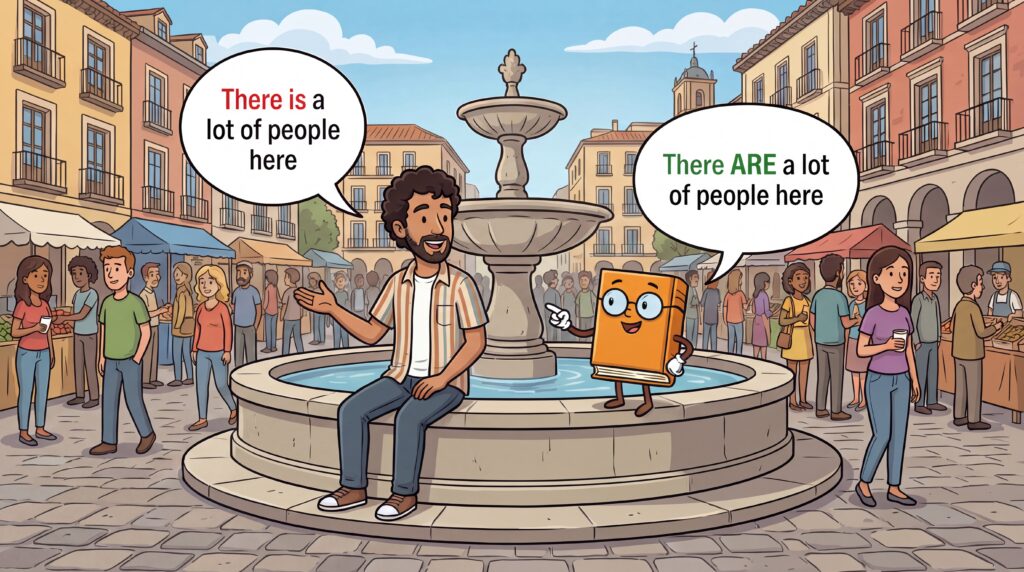
There is many building, and there is lots of people ❌
There are many buildings, and there are lots of people ✅
Speakers often use “There’s” as a filler chunk to start a sentence before they have decided what noun is coming next. By the time they realise the noun is plural, it’s too late. This is a universal problem.
However, it is notably very strong in Spanish 🇪🇸 and Portuguese 🇵🇹 speakers, as their equivalent word (Hay or Tem) doesn’t change for singular vs plural.
Mistake 4: Auxiliary Verb Errors
He don’t like ❌
She have to ❌
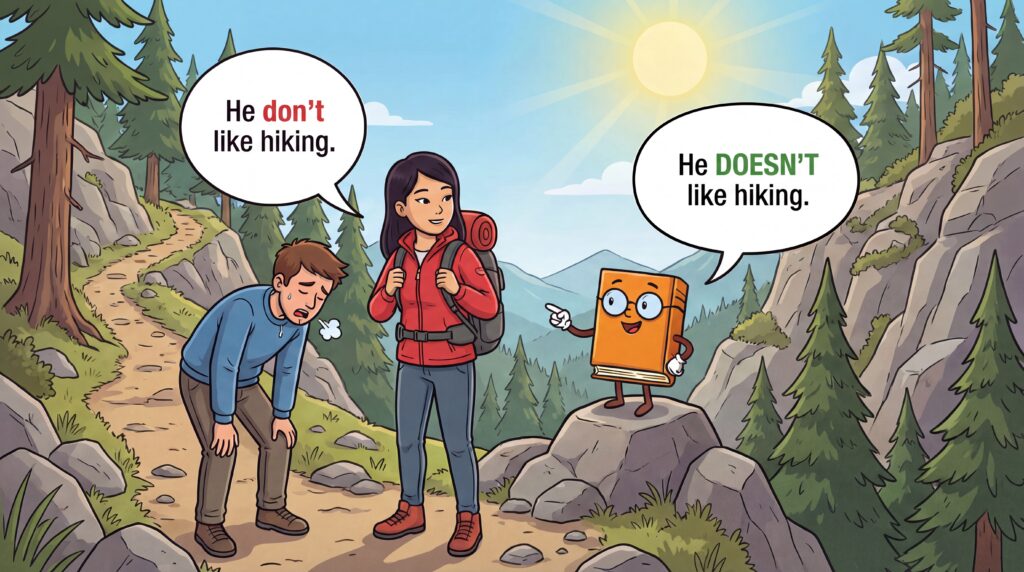
Similar to mistake #1, but slightly less frequent than main verbs. The “do/does” distinction is a major hurdle.
This is a common mistake among East/Southeast Asian learners. Also common in Slavic language speakers (🇵🇱, 🇨🇿, 🇸🇰, 🇺🇦, 🇧🇾, 🇷🇺, 🇸🇮, 🇭🇷, 🇷🇸, 🇧🇦, 🇲🇪, 🇲🇰, 🇧🇬) at intermediate levels.
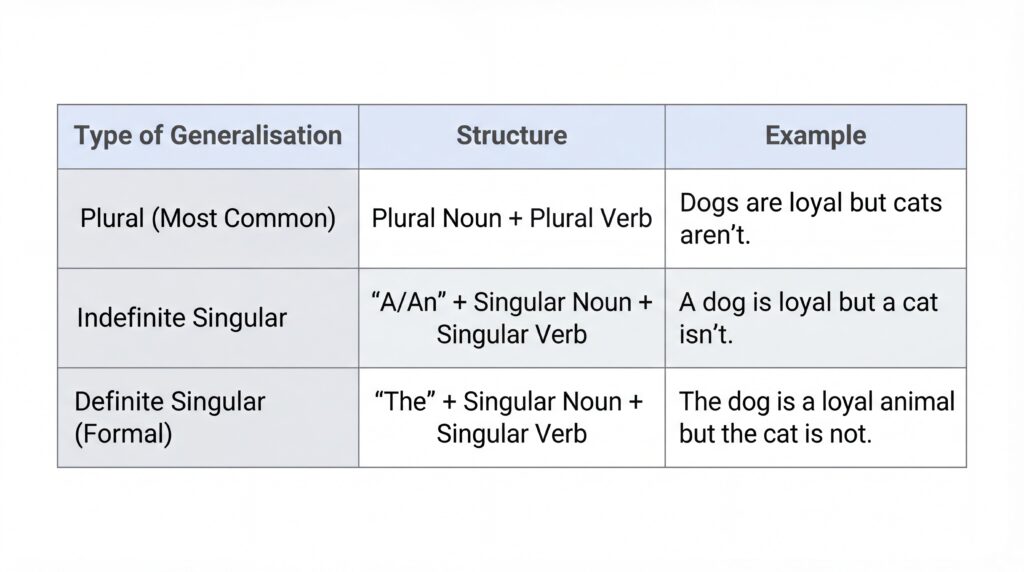
Mistake 5: Generalisation Mismatch (Singular Noun + Singular Verb when meaning Plural)
Phone is convenient ❌
Students want to talk generally, but use a singular noun (“Car is …”) instead of the plural general (“Cars are…”). The following sentences often get confused because they then switch to “they”. This is very common in Chinese 🇻🇳, Slavic, and Japanese speakers.
6: Indefinite Pronouns & Collective Nouns
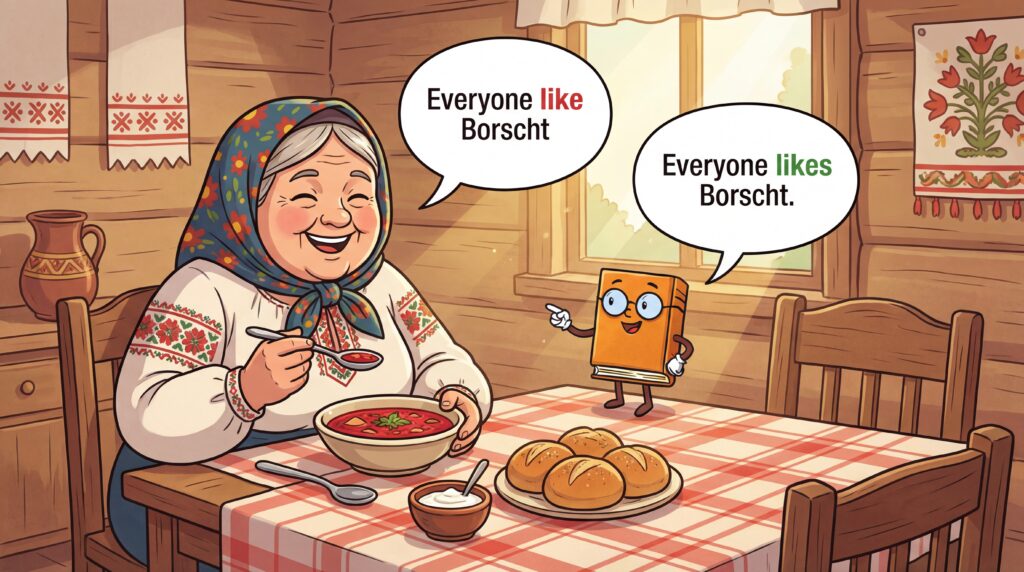
Everyone are happy ❌
Nobody know ❌
Many students translate collective nouns like: “everyone”, “everybody”, “Nobody” and “No one” and think they mean more than one person. However, in English they are treated as singular.
Mistake 7: Relative Clause Mismatch
I’m a person who loves sports ❌
They are people who loves sports ❌
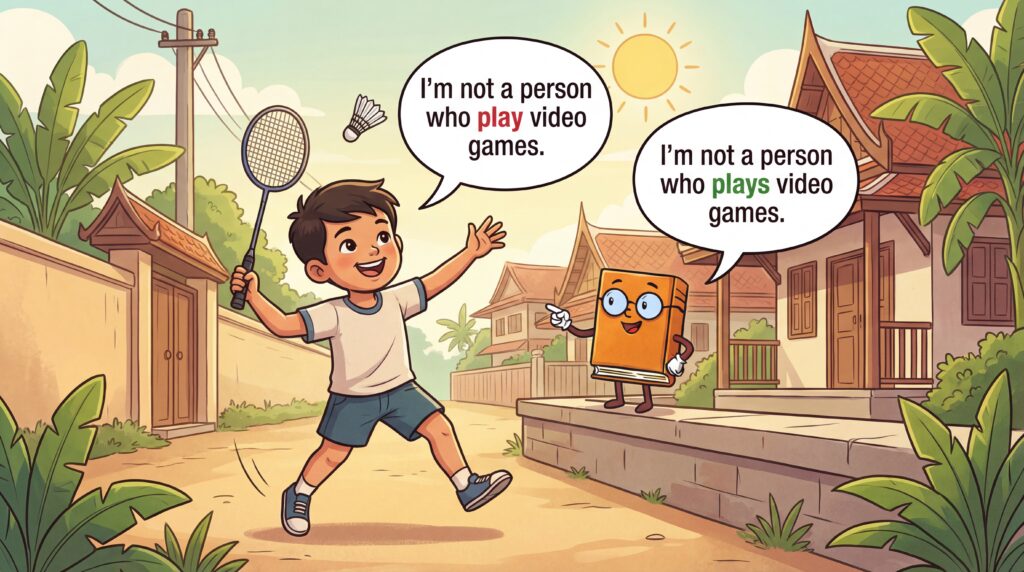
This is a frequent error for French, Italian, and Spanish (🇫🇷, 🇮🇹, 🇪🇸) speakers, as they try to form complex sentences early on.
Also common in Chinese 🇻🇳 speakers attempting higher-level grammar, as relative clauses operate backward in Mandarin compared to English.
Mistake 8: Uncountable Noun Confusion
The news are bad, The information were wrong, International travel are… ❌
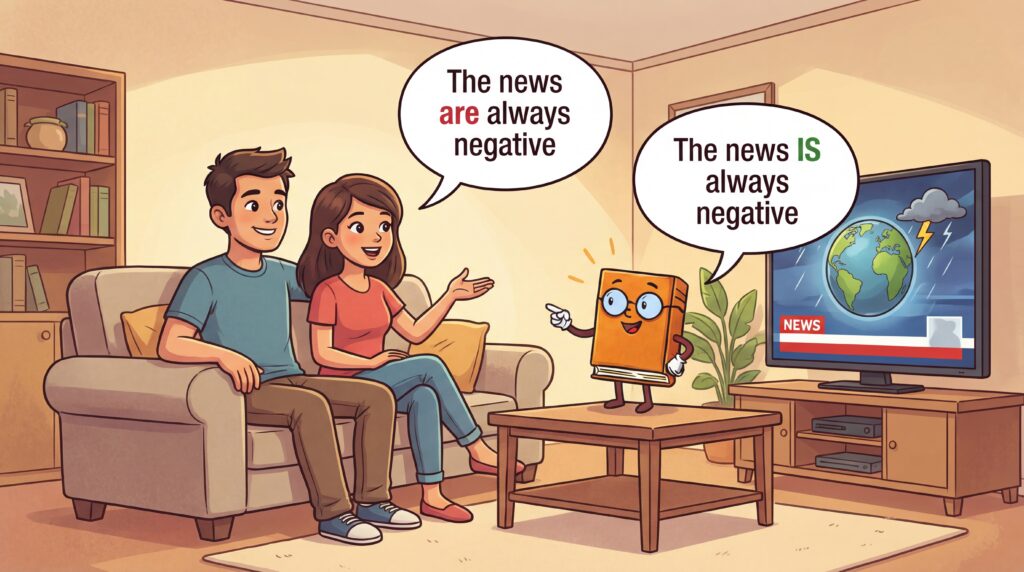
French/Italian/Spanish (🇫🇷, 🇮🇹, 🇪🇸): Very common errors with words like information, advice, news, which are often countable plural in their languages.
Slavic languages (🇵🇱, 🇨🇿, 🇸🇰, 🇺🇦, 🇧🇾, 🇷🇺, 🇸🇮, 🇭🇷, 🇷🇸, 🇧🇦, 🇲🇪, 🇲🇰, 🇧🇬): Often struggle with concepts like “money” or “hair” being singular.
Mistake 9. Distance/Prepositional Phrase Distraction
One of my best friends are coming ❌
The list of books were long ❌
Long sentences can cause students to loses track of the original subject head-noun and then end up using the wrong verb from.