A range of appropriate discourse markers and connectives is REQUIRED in order to get Band 7-9 in Grammar, while Band 6 can be achieved with just a range of these but not appropriately used. In this lesson, you’ll discover the discourse markers and connectives that examiners are looking out for.
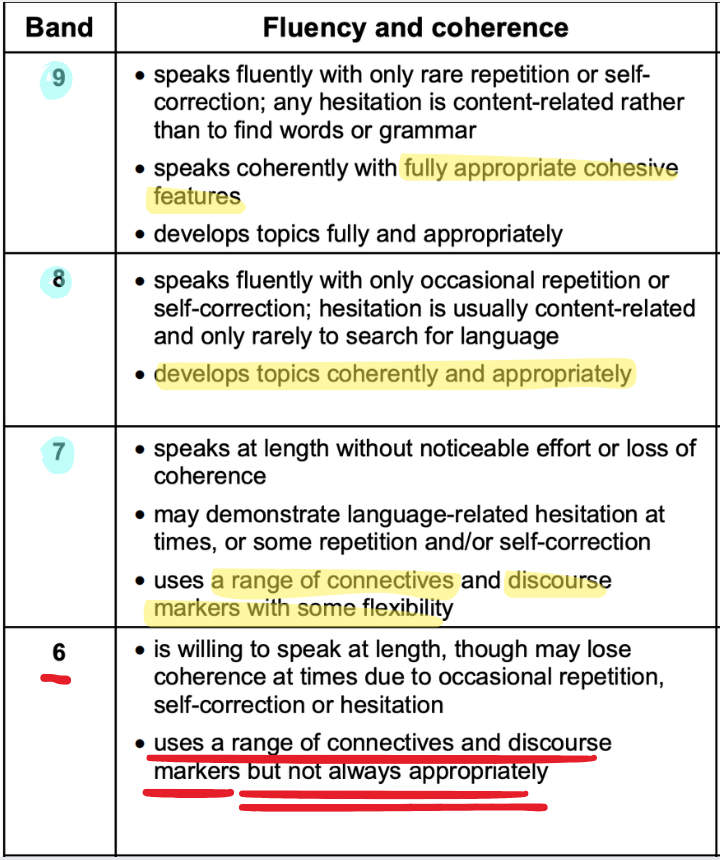
To hit a Band 7 in IELTS Speaking, master the basics like “and,” “but,” “so”, “or” and “because.” but also learn others. The examiners are looking for discourse markers (words that manage the flow and structure of your speech) and connectives (words that link ideas within a sentence). The “flexibility” part means you aren’t just memorising a list; you’re using them naturally to signal where your story or argument is going.
1) The “Adding More” Markers
To add another idea or point, we mostly use “and“, but to avoid being repetitive, native speakers use other options too. Try to not overuse these. You can use “and” 90% of the time and then use these once or twice only.


2) The “Contrast” Markers
To add show contrast, we mostly use “but“, but to avoid being repetitive, native speakers use other options too. You can use “but” 90% of the time and then use these once or twice only.


3) The “Examples” Markers
To introduce an example there are lots of options. You can use “for example“, “for instance” and “like” 90% of the time and then use the others once or twice only.


4) The “Being Direct” Markers
Some words and phrases are often used to either give a straightforward opinion about something or to admit something directly, often times it can be a controversial or debatable point.


5) The “Admission” Markers
Some words and phrases are often used to either give a straightforward opinion about something or to admit something directly, often times it can be a controversial or debatable point.


6) The “Thinking” Fillers
Some words and phrases are often used to either give a straightforward opinion about something or to admit something directly, often times it can be a controversial or debatable point.


7) The “Wrapping up” Markers
When speaking impromptu, we don’t always have a perfect way to conclude for our stories or explanations. We run out of steam, or we realise we’ve made our point and have nothing else to add. “So, yeah…” is a signal to the listener that the speaker’s turn is finished. It replaces a formal conclusion like, “And that is the end of my story.”


8) The “React” Markers
There are several reasons to use react markers.
1) They show you are actively listening.
2) They build emotional rapport.
3) They buy time to think.