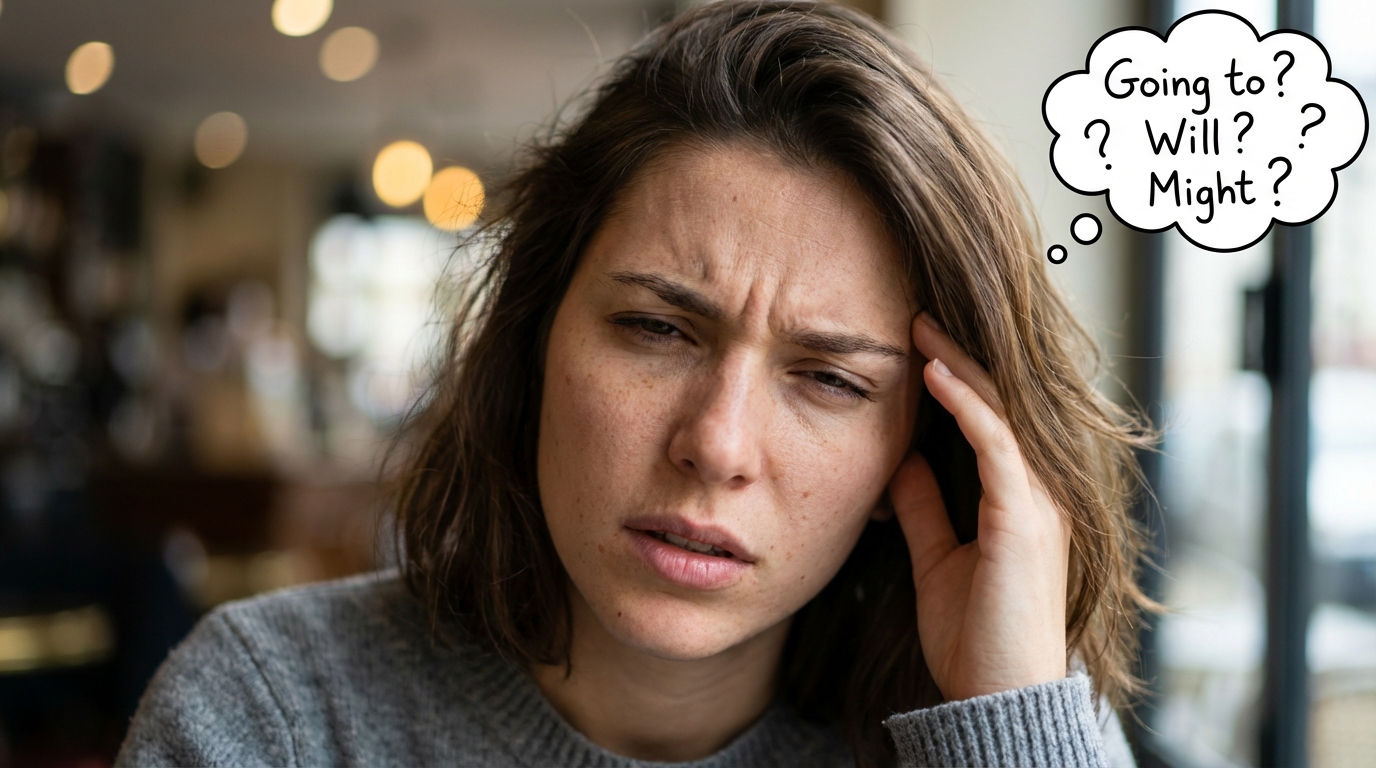
Very often in IELTS, you will need to express something using a future tense. Here are the main tenses to focus on:
1) Going to + verb
2) Will + verb
3) Present Continuous for future
4) Modals for future (might / may / could)
Going to v Will
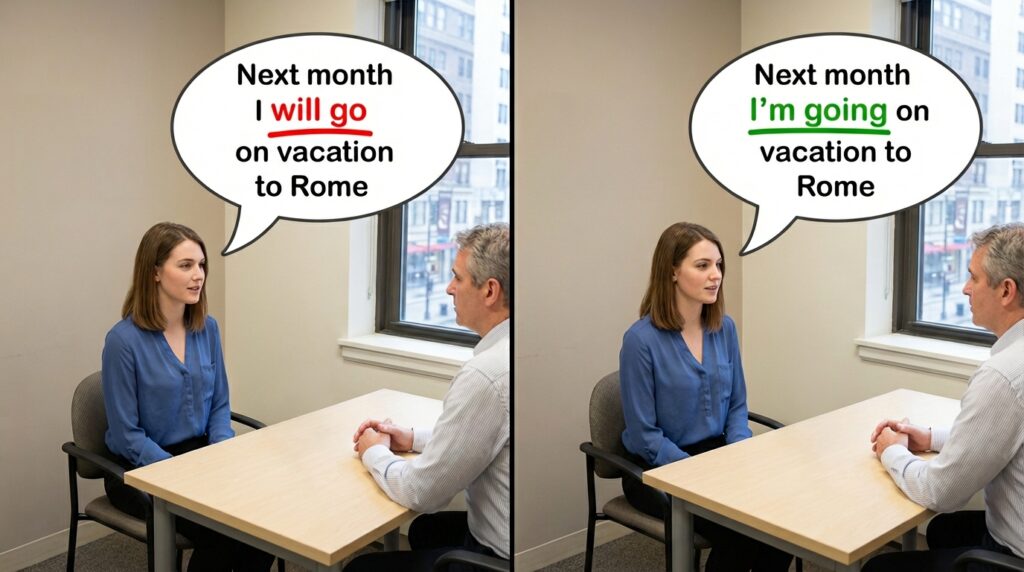
Generally, we Use going to for plans already decided, and use will for decisions or predictions made at the moment.
1. “Going to” – Plans & Intentions
Use it for:
✔️Plans already decided
✔️Intentions with some evidence
✔️Personal expectations
Common IELTS Scenarios
Speaking Part 1: daily life, weekends, hobbies
Speaking Part 2: personal future plans (work, education, travel)
Speaking Part 3: predictions you can support with reasons
Examples
I’m going to study architecture next year.
I’m going to visit my cousins this weekend.
Technology is going to change the way we communicate.
⭐ Certainty Level Guide -> 80%–90% certain
Meaning: A plan or intention you decided before speaking, OR a prediction based on evidence.
I’m going to study medicine. → 85% (decided)
Look at the clouds — it’s going to rain. → 90% (evidence)
KEY IDEA:
👉 A plan exists OR the evidence is visible.
Why it’s powerful for IELTS
It sounds natural, conversational, and shows certainty.
2. “Will” – Instant decisions, promises & general predictions
Use it for:
✔️Decisions made while speaking
✔️Offers / promises
✔️Predictions without evidence (opinions)
Common IELTS Scenarios
Part 1: Showing spontaneity
Part 3: Giving opinions about the future
Examples
Let me think… I’ll probably move to a bigger city later on.
I think people will rely more on online learning.
I’m not sure, but I guess cars will become fully automated.
⭐ Certainty Level Guide -> 50%–70% certain
Meaning: A prediction, a decision made now, a promise.
Not planned. Not arranged.
I think it’ll rain later. → 60%
I’ll call you tonight. → 70% (promise)
I’ll probably study abroad someday. → 50%
KEY IDEA:
👉 A guess — not fixed.
Why it’s useful
IELTS students often overuse “will.” But when used correctly, it shows natural decision-making.
Exercise 1: Will or Going to
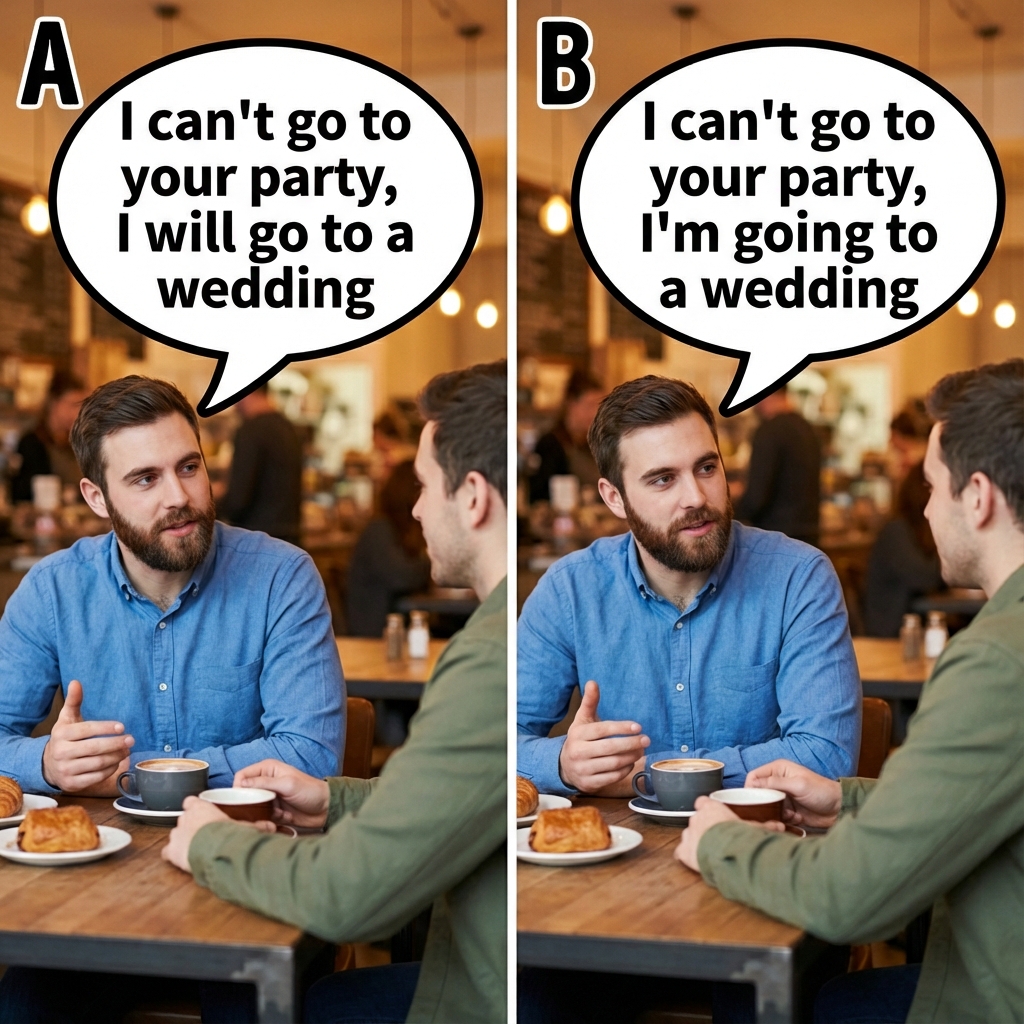
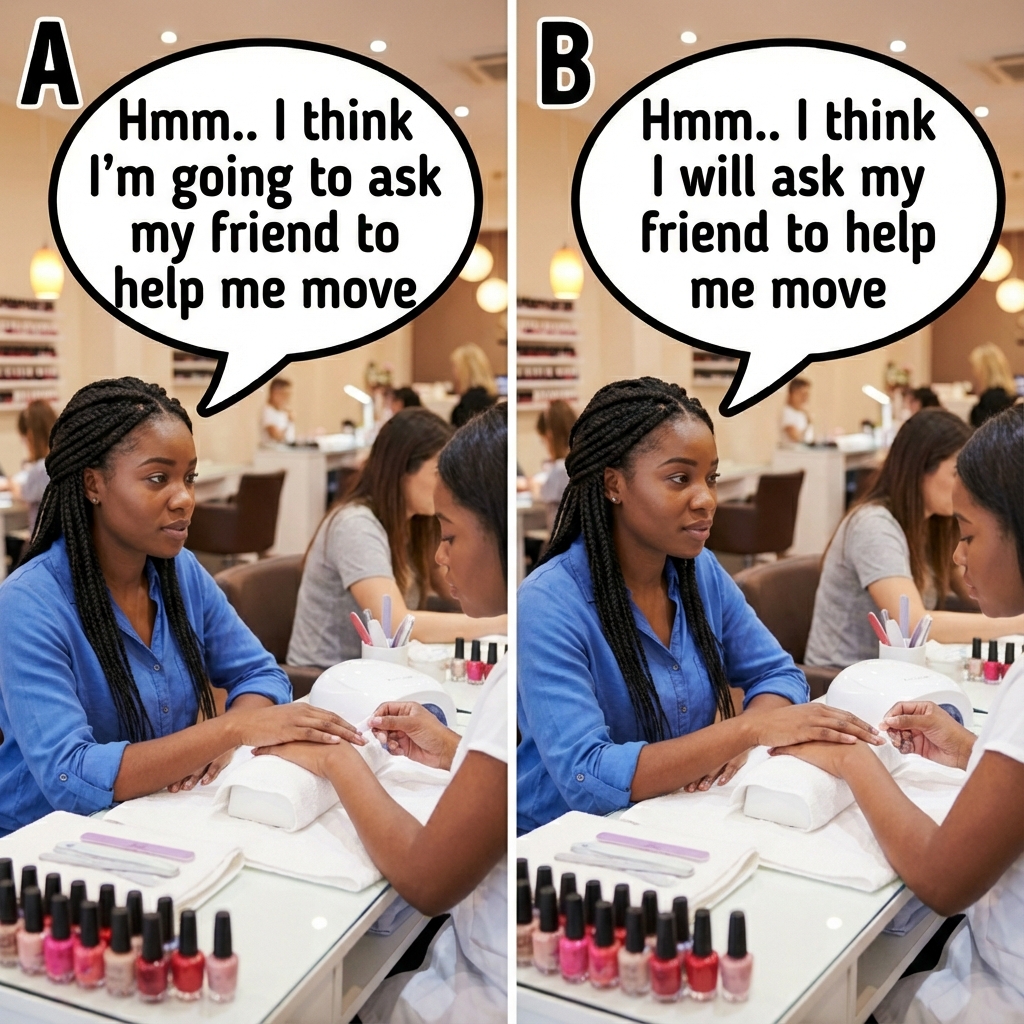
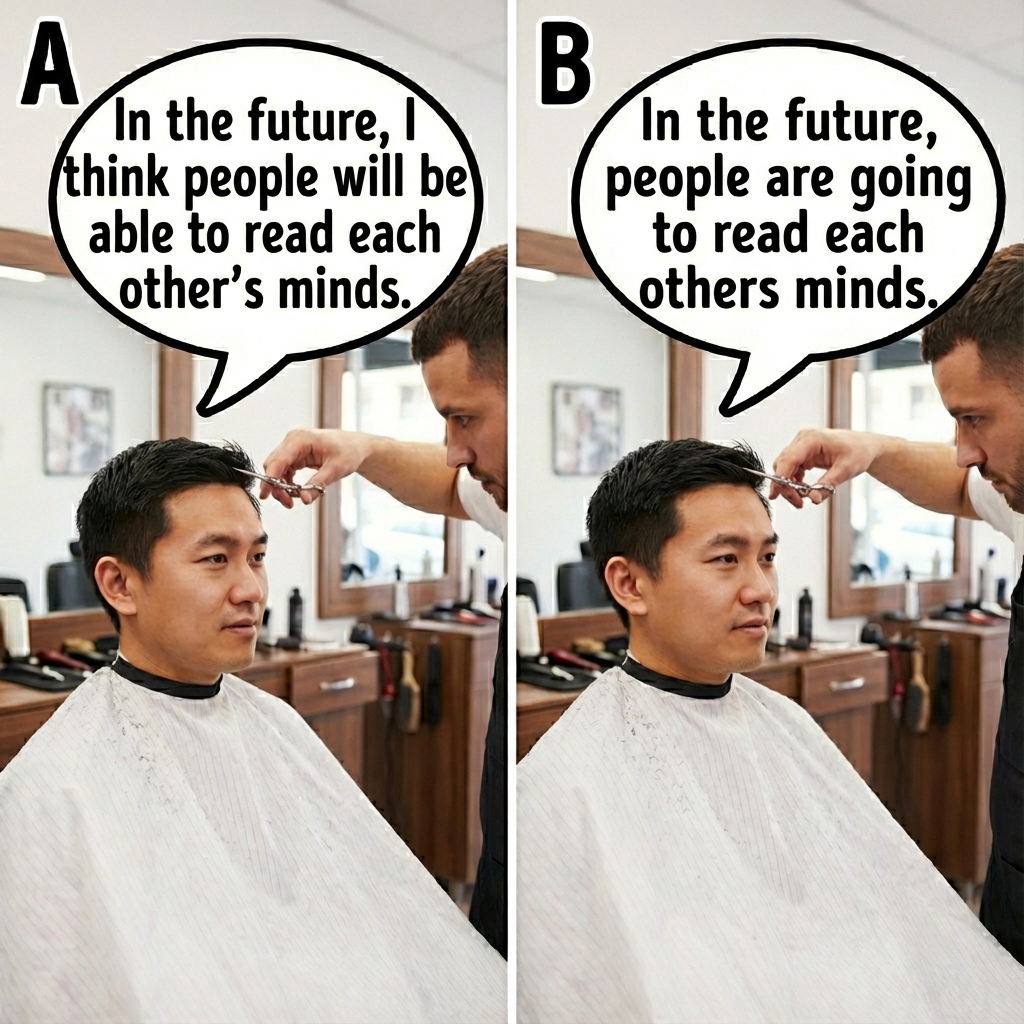
Which image is correct? Will or Going to?
Answer
B- I can’t go to your party. I’m going to a wedding.
For certain plans, use going to.
Answer
B- Hmm.. I think I will ask my friend to help me move.
If undecided, use will.
Answer
A- In the future, I think people will be able to read each other’s minds.
Predictions without evidence, use will.
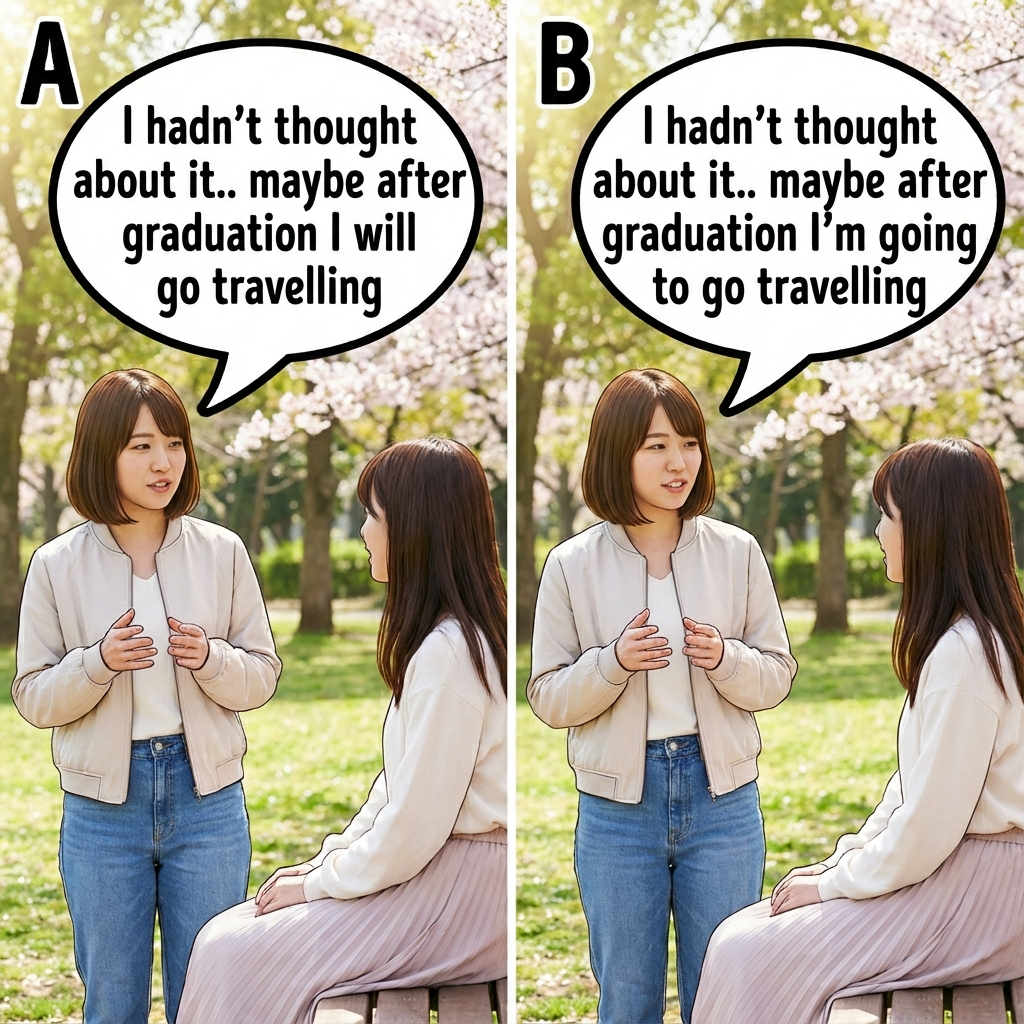
Answer
A- I hadn’t thought about it.. maybe after graduation I will go travelling.
If undecided, use will.
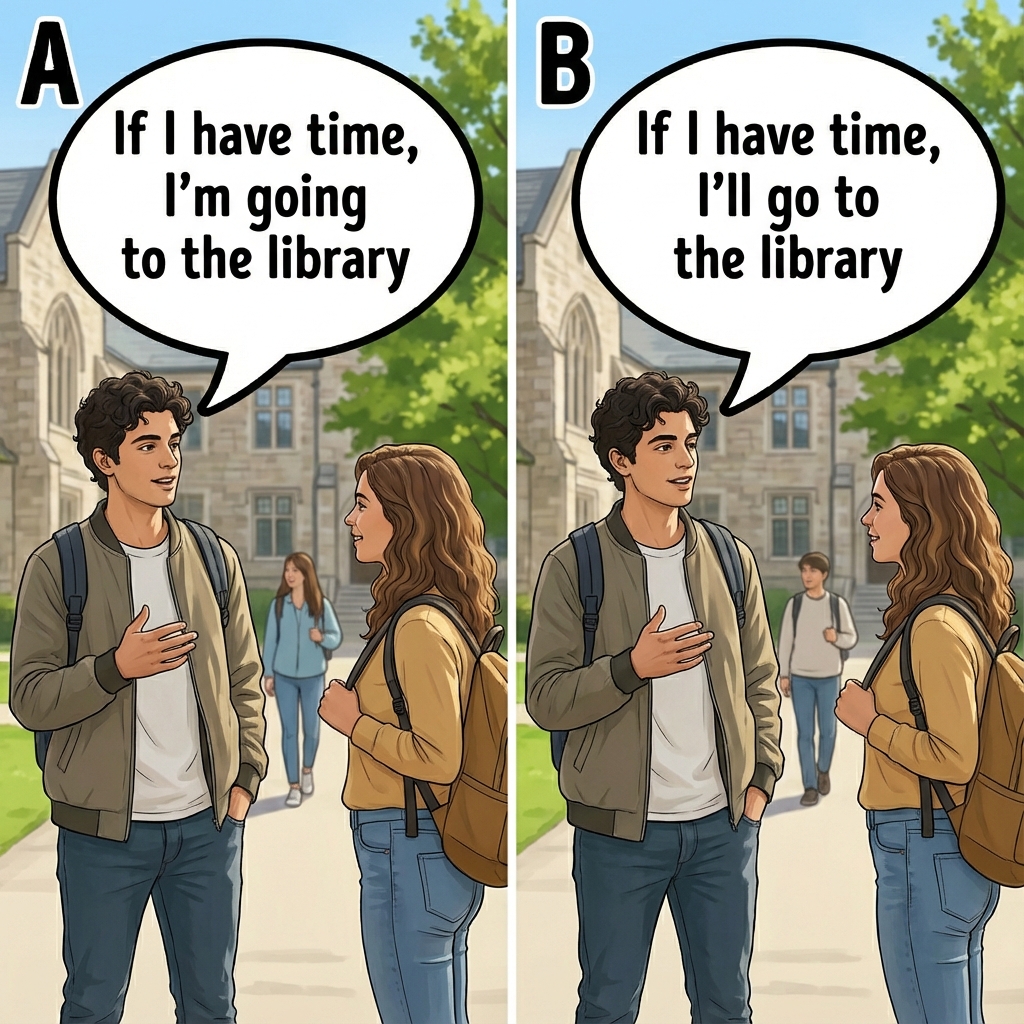
Answer
B- If I have time, I‘ll go to the library.
If undecided, use will.
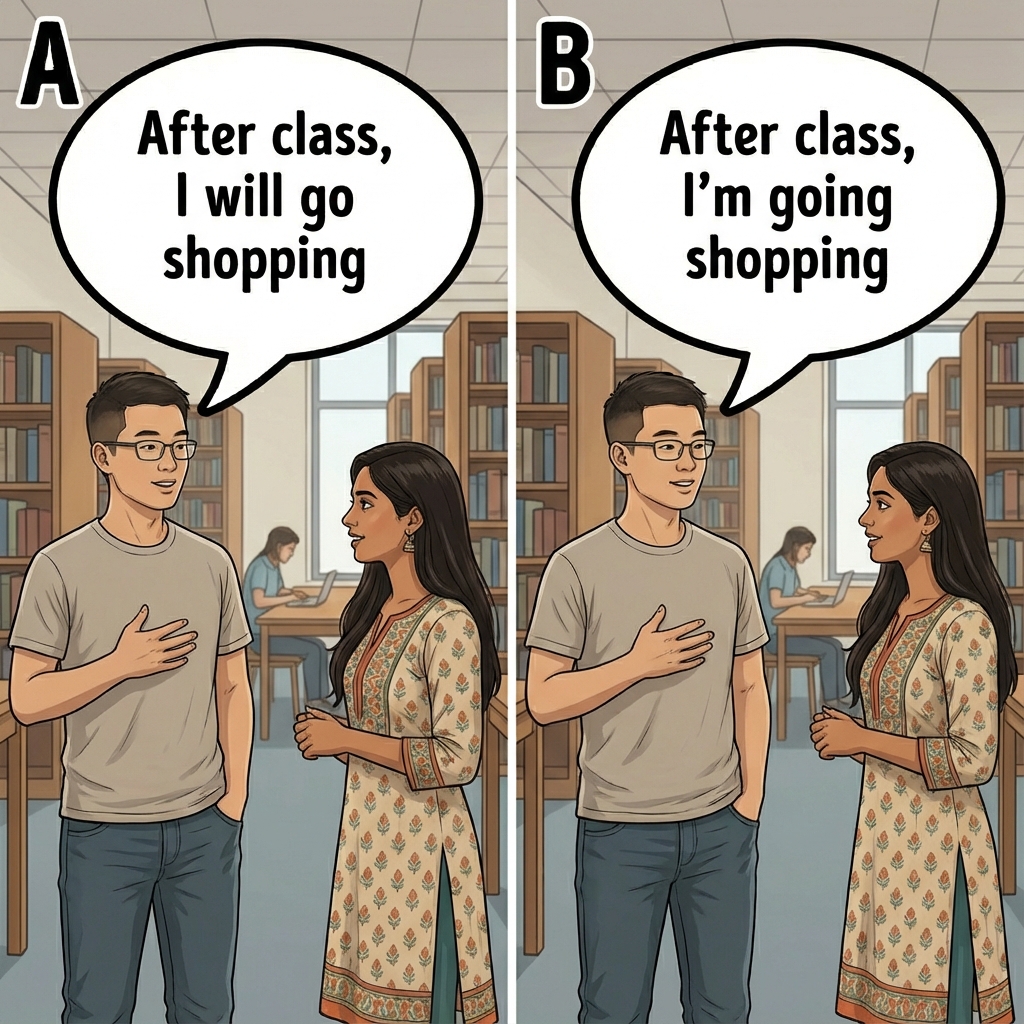
Answer
B- After class, I’m going shopping.
For certain plans, use going to.
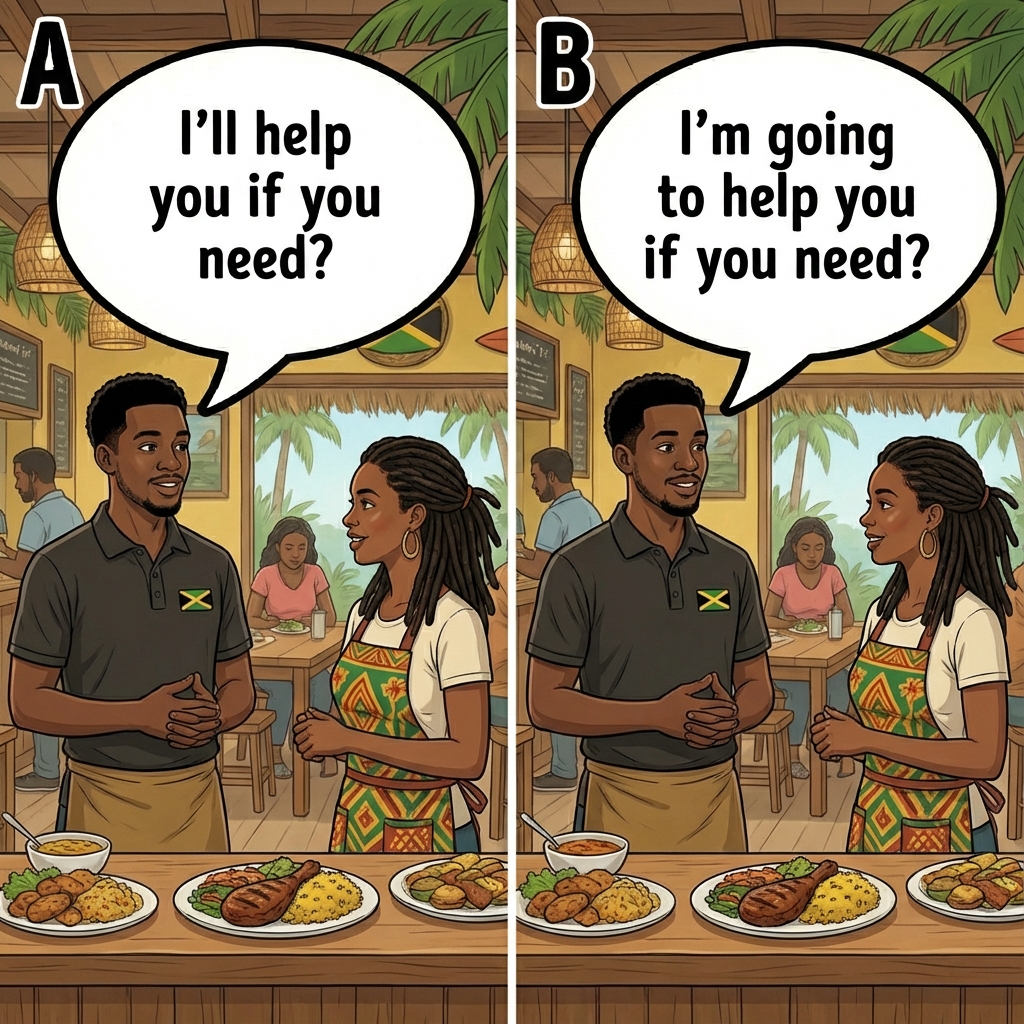
Answer
A- I‘ll help you if you need?
For offers, use will.
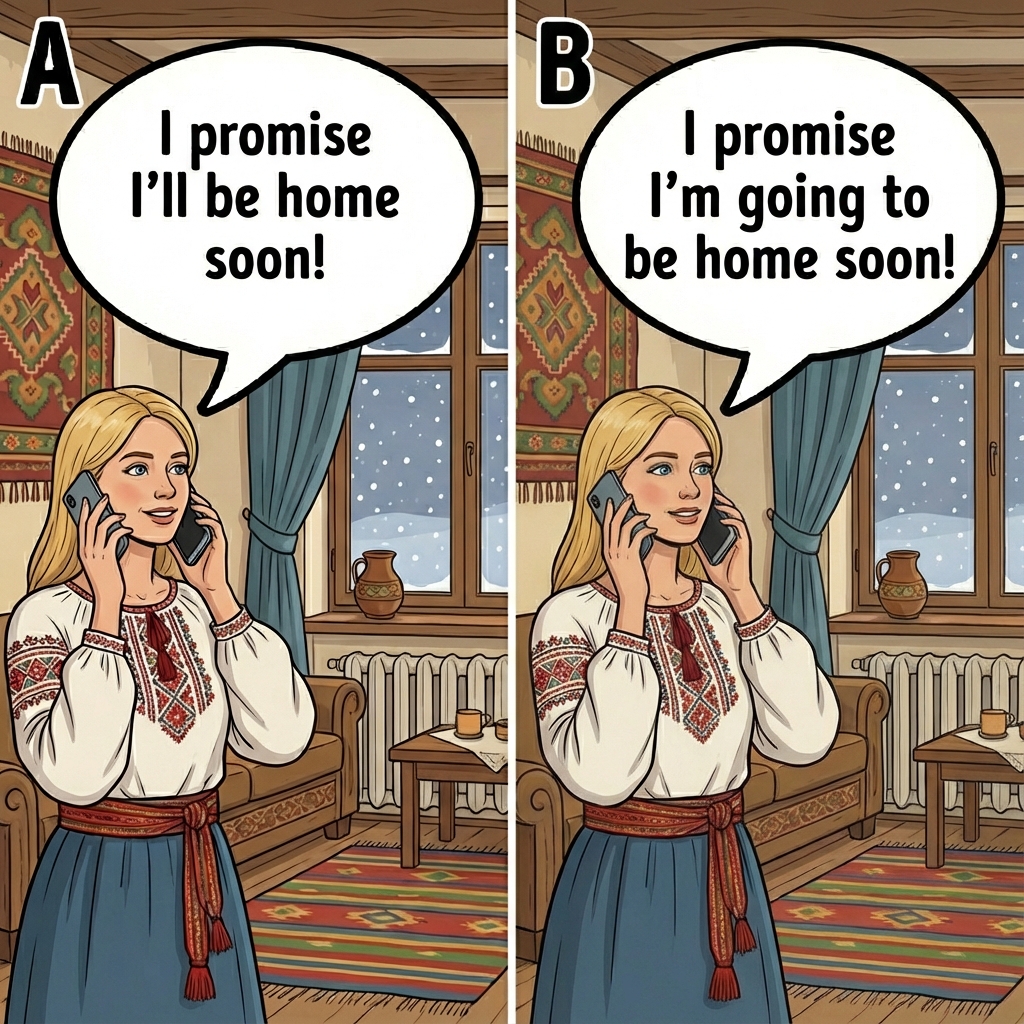
Answer
A- I promise I’ll be home soon!
For promises, use will.
3. Present Continuous for Scheduled Future
Use the present continuous (I’m doing…) to talk about future arrangements that are:
✔️ in your calendar,
✔️ organised with another person, company, or system,
✔️ confirmed or “locked in”.
It sounds more definite than “going to.”
⭐ Certainty Level Guide -> 95%–100% certain
Meaning: A future arrangement that is confirmed — on your schedule, booked, organised with someone.
I’m meeting my tutor tomorrow. → 100% (already arranged)
I’m flying to Japan next month. → 100% (ticket booked)
KEY IDEA:
👉 A fixed arrangement — as certain as it gets.
Note: Although we use present simple when something is scheduled by a timetable, we use present continuous when it is arranged by you.
1. Personal plans already booked
- I’m meeting a friend for lunch tomorrow.
- I’m travelling to Seoul this weekend.
- I’m starting a new course next month.
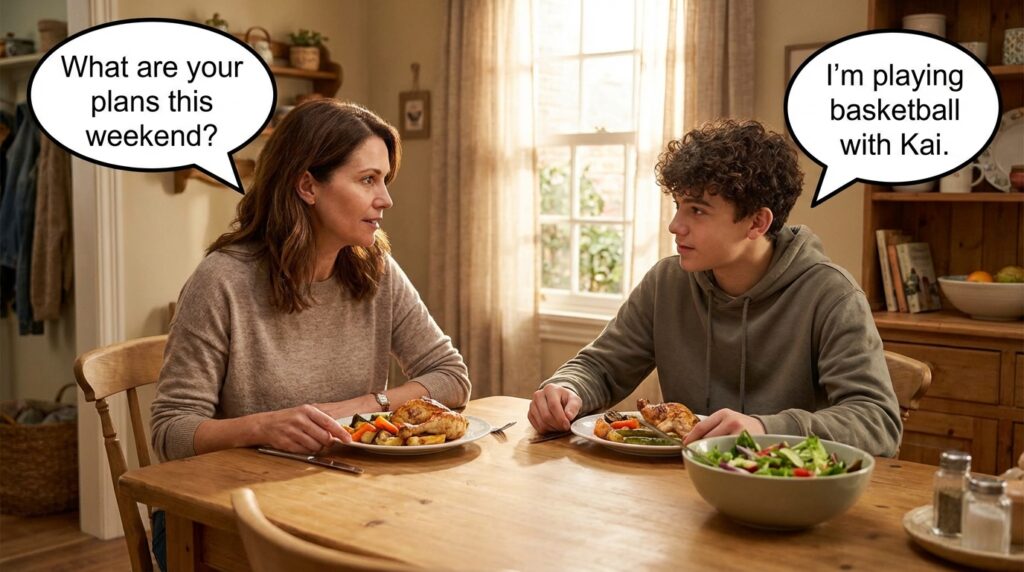
2. Work or study schedules
- I’m starting my internship in July.
- I’m giving a presentation next Tuesday.
- I’m taking my final exam next week.

Questions to answer with the Present Continuous (for the Future)
⚽ 1. “Are there any sports you like?”
✔️ Yeah, I love football. I’m actually playing in a local match this weekend.
✔️ Yes, definitely. I’m training with some friends later today, actually.
🎨 2. “Do you like painting?”
✔️ I do! I’m actually starting an evening art class tomorrow.
✔️ Yeah, I enjoy it. As a matter of fact, I’m meeting a friend this weekend to paint outside.
📚 3. “Do you read often?”
✔️ Absolutely — I’m actually visiting a book fair this Saturday.
✔️ Yes, and I’m starting looking for a new book to read right now actually!
🍳 4. “Do you like cooking?”
✔️ Yeah, I love it. I’m cooking dinner for my family tonight actually.
✔️ Definitely — I’m actually trying a new recipe this weekend.
✈️ 5. “Do you enjoy travelling?”
✔️ I do, yeah! In fact, I’m travelling to Vietnam next month.
✔️ Yes — I’m actually planning a short trip with my friends next weekend.
👯♂️ 6. “Do you like going out with friends?”
✔️ Sure! I’m meeting a couple of friends for coffee later today.
✔️ Yeah — we’re watching a movie together this Friday.
👨👩👧👦 7. “Do you often visit your family?”
✔️ Yeah, I try to. I’m visiting them this Sunday, actually.
✔️ Pretty often — I’m actually having dinner with them tomorrow night.
🎵 8. “Do you like music?”
✔️ Absolutely. I’m attending a concert of my favourite band next weekend actually.
✔️ Yeah I love it, and you know, I’m actually starting guitar lessons next month.
📘 9. “Do you enjoy studying English?”
✔️ Yeah, I do! Funnily enough, I’m joining an online speaking group this weekend.
✔️ I do actually! I’m studying with a friend next week.
🏡 10. “Do you like your hometown?”
✔️ Yes, I do. I’m returning there this holiday to see my family actually!
✔️ Yeah I love it! — I’m actually visiting next month for a festival.
Exercise 2: Answer with present continuous
Task: Answer aloud using the present continuous tense. The first question has been done for you.
1) Do you enjoy going to the cinema?- Yea I go regularly!
Actually I‘m heading to the cinema this weekend with my girlfriend!
2) Do you like shopping?
3) Are you into video games?
4) Do you enjoy going to the gym?
5) Do you often watch TV shows or movies?
6) Do you like learning new skills?
7) Do you enjoy eating out at restaurants?
8) Are you interested in fashion?
9) Do you like spending time outdoors?
10) Do you enjoy celebrating holidays or festivals?
4) Modals for future (might / may / could)
⭐ Why modals are important in IELTS Speaking
They help you sound:
✔️ natural
✔️ realistic
✔️ not too certain
✔️ thoughtful and balanced
This is exactly what examiners want in Part 3, where answers should sound analytical, not “black and white.”
What do “might / may / could” express?
All three express uncertainty / possibility, but there’s a slight difference in strength:
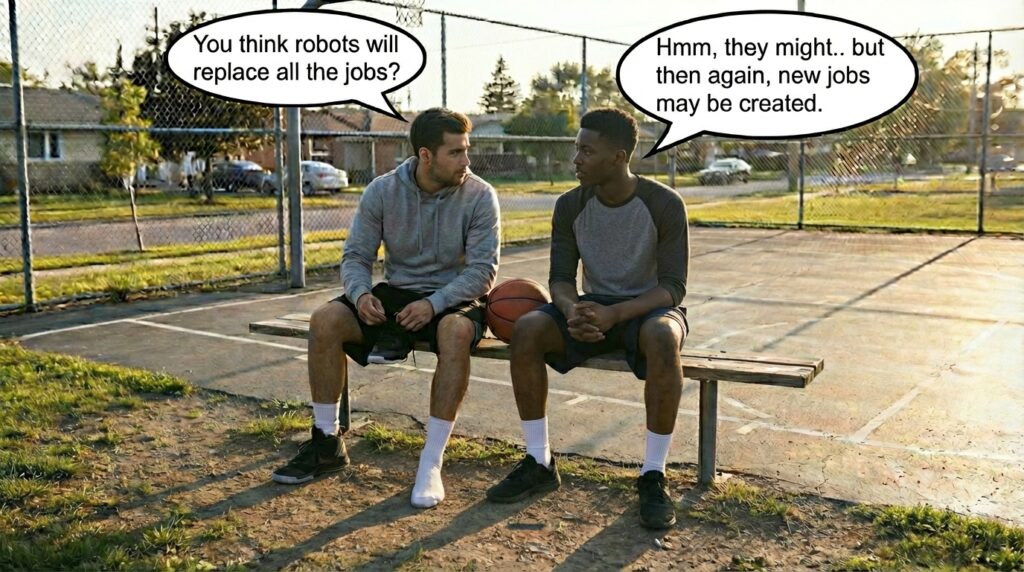
may / might → 40–60% likely
Could → 30–50% possible
None of them show a definite future — they show a possible future.
When to use modals for the future in IELTS
1️⃣ 🤷♂️🤷♀️ When you want to show you are NOT totally sure
This is perfect for Part 3 when giving predictions.
Examples:
I think people might travel more in the future.
Education may become more flexible in the next decade.
Cities could become more crowded if the population keeps rising.
2️⃣ 🫥 When you don’t want to sound too strong or absolute
IELTS examiners don’t like extreme, over-confident answers.
Instead of:
❌ People will stop using cash. (too certain)
Use:
✔️ People might stop using cash.
✔️ People could switch to digital payments.
This shows maturity in thinking.
3️⃣ 🌍🔮 When the question is about “the future of society”
These questions are impossible to answer with certainty, so modals sound more natural.
Questions like:
How will families change in the future?
Do you think people will travel more in the future?
What will cities look like in 50 years?
Good responses:
Families might become more spread out.
People may prefer virtual tourism.
Cities could use more renewable energy.
4️⃣ 🎒❓When talking about your own uncertain plans
Especially in Parts 1 and 2.
Examples:
I might do a master’s degree if I can afford it.
I may move to another city after I graduate.
I could take a gap year — I haven’t decided yet.
5️⃣ 🧩 When listing possibilities
Modals make your answer richer and longer.
Example (Part 3):
There are a few possibilities. Public transport might improve, or people may start using electric scooters more. Another option could be driverless taxis.
This shows fluency and flexibility.
Exercise 3 — Fill in the blanks (might / may / could)
Complete each sentence with the most natural modal.
- I’m not sure yet, but I ____ take an English course next month.
- In the future, people ____ work from home more often.
- I ____ visit my grandparents this weekend, depending on my schedule.
- The weather looks unpredictable, so it ____ rain later.
- With new technology, students ____ study in virtual classrooms.
- I ____ change jobs next year if I find something better.
- Cars ____ become fully electric in the next 20 years.
- I ____ not join the meeting tomorrow because I’m feeling unwell.
- Our school ____ introduce more online subjects soon.
- I’m thinking I ____ move abroad after I graduate.
Answers
1. I’m not sure yet, but I _may/might_ take an English course next month.
2. In the future, people _could/ may/might_ work from home more often.
3. I _may/might_ visit my grandparents this weekend, depending on my schedule.
4. The weather looks unpredictable, so it _may/might_ rain later.
5. With new technology, students _could/ may/might_ study in virtual classrooms.
6. I _may/might_ change jobs next year if I find something better.
7. Cars _could/may/might_ become fully electric in the next 20 years.
8. I _may/might_ not join the meeting tomorrow because I’m feeling unwell.
9. Our school _may/might_ introduce more online subjects soon.
10. I’m thinking I _may/might_ move abroad after I graduate.
Exercise 4 — All Future Tenses (Going to/ Will/ might / may / could)
Choose which modal sounds most natural in context.
- I’m not sure what to eat for lunch. I (might / will / am going to) try that new sandwich place.
- Scientists say we (may / are going to / will definitely) find life on another planet someday.
- I’m quite busy this weekend, so I (could / will / am starting) visit you next week instead.
- People (may / are going to / will) travel less because of rising prices.
- My laptop is starting to slow down, so I (might / am going to / will definitely) buy a new laptop soon.
Answers
1. I’m not sure what to eat for lunch. I (might / will / am going to) try that new sandwich place.
2. Scientists say we (may / are going to / will definitely) find life on another planet someday.
3. I’m quite busy this weekend, so I (could / will / am starting) visit you next week instead.
4. People (may / are going to / will) travel less because of rising prices.
5. My laptop is starting to slow down, so I (might / am going to / will definitely) buy a new laptop soon.