As a Band 6 student, you can already express complex ideas in English. However, under the pressure of the exam, old habits often return, leading to basic errors with singular/plural nouns and matching them to the correct verbs or quantifiers.
Examiners notice these errors immediately. To reach Band 7, you must eradicate these “fossilised” mistakes to show control over standard grammar rules.
Here is a guide to the most common traps based on actual student errors, organised by grammatical rule.
Section 1: Making Generalisations
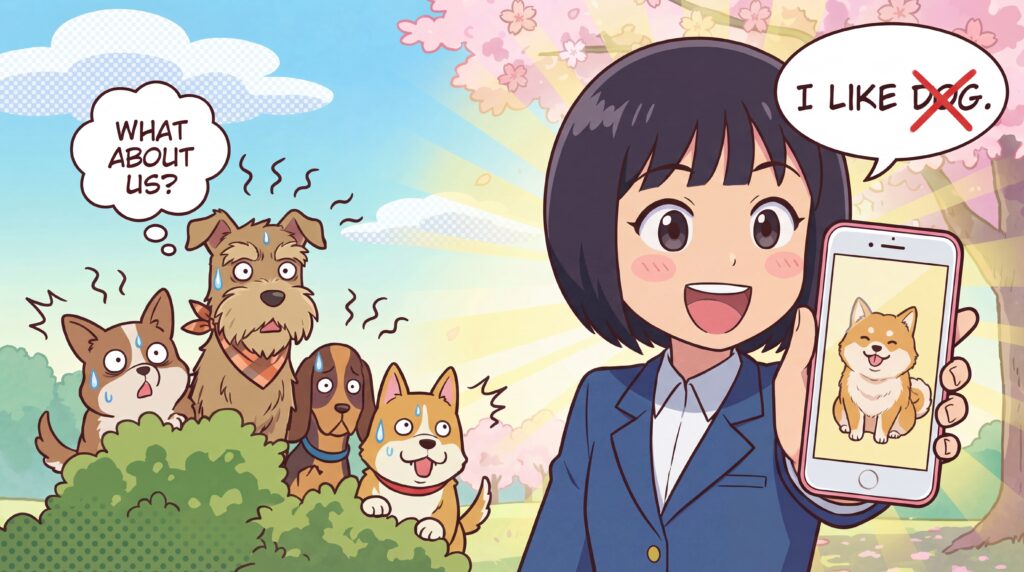
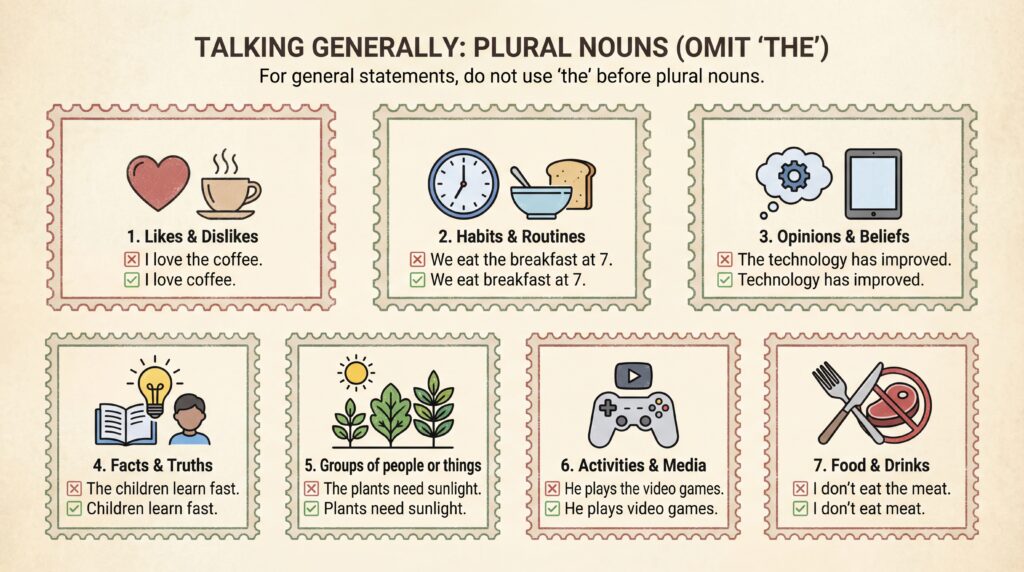
Band 6 students often use a singular noun without articles (a/the) to make general statements, which sounds unnatural.
The Rule: To speak generally, use the plural noun (usually with no article).
❌ Incorrect: Bus is convenient.
✅ Correct: Buses are convenient.
❌ Incorrect: I don’t like big city.
✅ Correct: I don’t like big cities.
❌ Incorrect: I watch movie when I’m bored.
✅ Correct: I watch movies when I’m bored.
Section 2: “Of” Phrases
The Rule: When using phrases like “one of the…” or “types of…”, the noun that follows must usually be plural.

1. Talking about favourites
❌ Mistake: It is one of my favourite place.
💡 Why: You have many favourites; this is just one item out of that group.
✅ Fix: It is one of my favourite places.
2. Discussing causes
❌ Mistake: One of the major reason is…
💡 Why: There are many reasons total; this is just one of them.
✅ Fix: One of the major reasons is…
3. Describing varieties
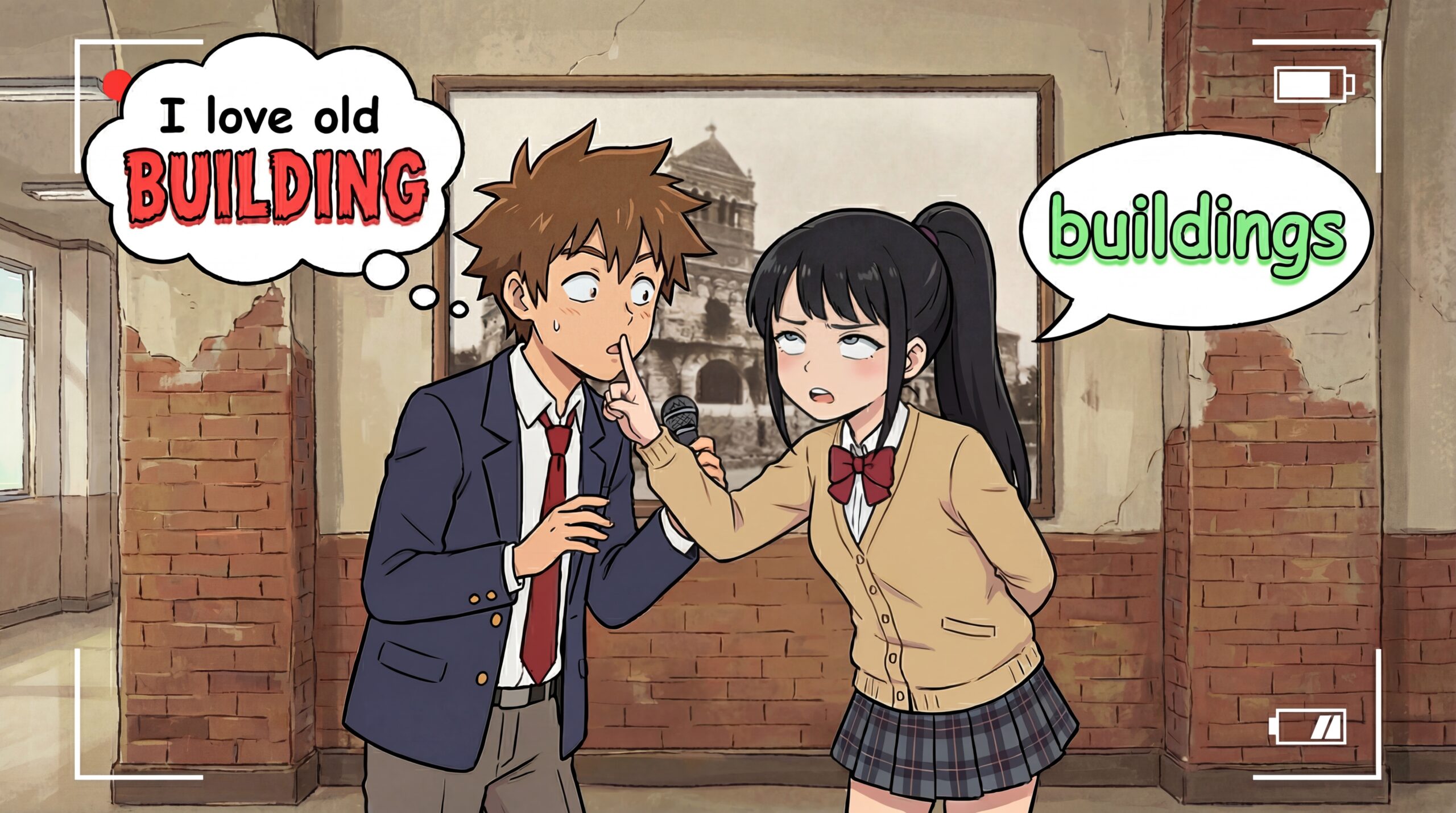
❌ Mistake: Different kind of building.
💡 Why: Plural “kinds” requires plural “buildings.”
✅ Fix: Different kinds of buildings.
Note: The same goes for “all of the …“, “some of the…“, “most of the…“, “the majority of the…“, and “a few of the…“.
Section 3: Subject-Verb Agreement Traps
Sometimes the noun is correct, but the student matches it to the wrong verb form.
Indefinite Pronouns
Words referring to huge groups often trick your brain into using a plural verb.
The Rule: Words ending in -one, -body, or -thing are grammatically SINGULAR. Treat them as if you are saying “he” or “it”.
❌ Mistake: Everyone know that health is important.
💡 Why: “Everyone” is grammatically singular.
✅ Fix: Everyone knows that health is important.
❌ Mistake: Everybody are looking for happiness.
💡 Why: “Everybody” requires ‘is’ (singular).
✅ Fix: Everybody is looking for happiness.

Section 4: Irregular Plural Nouns
Usually, we add ‘s’ to make a noun plural. However, this is not the case for some very common nouns.

4 biggest mistakes:
❌ Mistake 1: Mens usually like technology.
💡 Why: “Man” = singular, “Men” = plural.
✅ Fix: Men usually like technology.
❌ Mistake 2: Womens usually like makeup.
💡 Why: “Woman” = singular, “Women” = plural.
✅ Fix: Women usually like makeup.
❌ Mistake 3: Childrens usually like playing.
💡 Why: “Child” = singular, “Children” = plural.
✅ Fix: Children usually like playing.
❌ Mistake 4: Peoples usually like music.
💡 Why: “Person” = singular, “People” = plural.
✅ Fix: People usually like music.
Note: Some other mistakes are: Lifes ➡️ Lives, Knifes ➡️ Knives, Wifes ➡️ Wives, Leafs ➡️ Leaves, Thiefs ➡️ Thieves, Sheeps ➡️ Sheep, Wolfs ➡️ Wolves, Foots ➡️ Feet, Tooths ➡️ Teeth, Mouses ➡️ Mice, Deers ➡️ Deer, Fishes ➡️ Fish (this depend on whether you’re pluralising 1 species or talking about multiple species.)
Section 5: Each & Every
These words focus on individuals one by one, NOT the group as a whole.
The Rule: Each and Every must be followed by a singular noun AND a singular verb.
❌ Each people should work hard.
✅ Fix: Each person should work hard.
❌ Every cars must have seatbelts.
✅ Fix: Every person must have seatbelts.

Section 6: Another, Other & Others
This group of words causes frequent errors because they look similar but perform different grammatical jobs. You must know if the noun is singular or plural, and specific (“the”) or general.



“Another“
Think of “another” as “an + other.” Because “an” is for singular nouns, “another” must also be singular. It means “one more” or “a different one.”
Rule: “Another” + Singular Noun
❌ I want to see another countries.
✅ Fix: I want to see other countries.
“Other” vs. “Others“
This is a major trap. You use these when talking about general plural items. The difference is whether you include the noun or not.
- Other (Adjective): Must be followed by a plural noun. (e.g., Other books)
- Others (Pronoun): Replaces the noun entirely. It stands alone. Never put a noun after “others.”
❌ I want to go to other country.
✅ I want to go to other countries.
✅ I want to go to others.
“The other” vs. “The others”
Use “the” when you are talking about a specific, remaining individual or group that the listener/reader already knows about.
- The other + singular/plural noun: I have two pens. One is red; the other pen is blue.
- The others (pronoun): Stands alone representing the specific remaining group. I have five pens. One is red; the others are blue.
❌ I liked this juice but I didn’t like other.
✅ I liked this juice but I didn’t like the other.
✅ I liked this juice but I didn’t like the others.
Section 7: Demonstratives (This/That vs. These/Those)
You must ensure these pointing words match the noun immediately following them.
The Rule: Match singular with singular, and plural with plural.
❌ I like this games.
✅ Fix: I like these games.
❌ I don’t like these type of person.
✅ Fix: I don’t like this type of person.
Note: Sometimes students’ accents are a problem.
Many languages like Romance languages (🇫🇷, 🇪🇸, 🇮🇹, 🇵🇹, 🇷🇴) and Asian languages ( 🇯🇵, 🇨🇳, 🇰🇷, 🇹🇭, 🇻🇳, 🇮🇩, 🇲🇾) don’t have the /ɪ/ sound, so “this” and “these” are often pronounced too similarly. Slavic languages (🇷🇺, 🇺🇦, 🇧🇾, 🇧🇬, 🇷🇸, 🇲🇰), on the other hand, tend to struggle a bit with the /iː/ sound.

Test
Part 1: Error Correction
Instructions: Each sentence below contains exactly one grammar error related to the rules covered in this guide. Find the error and rewrite the sentence correctly.
- I really enjoy reading book in my free time.
Correction: - Almost everybody in my class agree that math is difficult.
Correction: - The shop sells clothes for mens and womens.
Correction: - Paris is one of the most beautiful city in the world.
Correction: - Every students have to take the final exam.
Correction: - Look at these beautiful flower in the garden.
Correction: - I don’t like this phone; please show me another ones.
Correction: - There were many sheeps blocking the road.
Correction: - Some people like tea, while others people prefer coffee.
Correction: - There are many different type of food available in my country.
Correction:
Part 2: Multiple Choice
Instructions: Choose the correct option to complete the sentence quickly. This simulates the pressure of speaking in real-time, where you must select the right grammar instinctively.
- Generally speaking, I think ____ are very intelligent pets.
A) dog
B) the dog
C) dogs - Everything in that expensive shop ____ overpriced.
A) are
B) is
C) were - We need to make sure that ____ participant understands the rules.
A) all
B) some
C) each - The park was full of playing ____ yesterday afternoon.
A) childrens
B) childs
C) children - I’ll have one cup of coffee now, and ____ one later.
A) other
B) another
C) others - To be honest, I don’t really like ____ kinds of movies.
A) that
B) this
C) these - One of the major ____ for traffic is poor urban planning.
A) reason
B) reasons
C) reasoning - Some students went home early, but the ____ stayed to study.
A) others
B) other
C) another - Every ____ on that street has a different color door.
A) houses
B) house
C) housing - Many ____ believe that technology is improving our lives.
A) persons
B) peoples
C) people
Part 3: Paragraph Editing
Instructions: Read the short paragraph below. It sounds like a typical Band 6 student response about healthy living. There are FIVE grammar errors in the text related to plurals, quantifiers, and agreement. Find them and correct them directly in the text.
Paragraph A (Topic: Work & Technology)
In modern offices today, almost everyone rely on computers to do their jobs. This has changed how we communicate. One of the major benefit of technology is speed. However, it can also be stressful because technology creates too many distraction during the workday.
Paragraph B (Topic: The Environment)
Pollution is a serious problem in most big city around the world. There are different kind of vehicles on the road, and they all release harmful fumes. I think that electric bus are a good solution for the future of urban transport.
Paragraph C (Topic: Shopping habits)
I love shopping for clothes. I usually buy things for myself, but sometimes I buy gifts for another people. I hate busy shops with loud music; I find those kind of environment very stressful. Also, I have to be careful because I often spend too many money when I go out.
Answers
Reveal Answers
Part 1: Error Correction
- I really enjoy reading books in my free time.
- Almost everybody in my class agrees that math is difficult.
- The shop sells clothes for men and women.
- Paris is one of the most beautiful cities in the world.
- Every student has to take the final exam.
- Look at these beautiful flowers in the garden.
- I don’t like this phone; please show me another one.
- There were many sheep blocking the road.
- Some people like tea, while others prefer coffee. (or: other people prefer)
- There are many different types of food available in my country.
Part 2: Multiple Choice
11. C (dogs)
12. B (is)
13. C (each)
14. C (children)
15. B (another)
16. C (these)
17. B (reasons)
18. A (others)
19. B (house)
20. C (people)
Part 3: Paragraph Editing (Corrections in bold)
Paragraph A
In modern offices today, almost everyone relies (1) on computers to do their jobs. This has changed how we communicate. One of the major benefits (2) of technology is speed. However, it can also be stressful because technology creates too many distractions (3) during the workday.
Paragraph B
Pollution is a serious problem in most big cities (4) around the world. There are different kinds (5) of vehicles on the road, and they all release harmful fumes. I think that electric buses are (6) a good solution for the future of urban transport.
Paragraph C
I love shopping for clothes. I usually buy things for myself, but sometimes I buy gifts for other people (7). I hate busy shops with loud music; I find those kinds (8) of environments (9) very stressful. Also, I have to be careful because I often spend too much money (10) when I go out.